Monday, June 16, 2008

Japanese use computer tomography to analyze fragile ancient artifacts

It's not often that I get to read an article about both of my personal passions - computer technology and ancient archaeology!

"Archaeologists working at an ancient tomb in Kurashiki, Okayama Prefecture, are taking advantage of a newly developed, computer-based technique that allows unearthed artifacts to be examined without risking damage by physically handling them.

The technique involves first encasing artifacts in medical resin to protect them from harm. Computer-based technology then applies the principles of tomography--the study of the internal structure of solid objects--to generate three-dimensional images that reveal the encased items in great detail.

Okayama University and the Kyushu National Museum, which jointly developed the method, have used it to examine artifacts found at the late fifth-century Shobuzako tomb in Kurashiki.

Excavation work at the tomb last year uncovered an intact stone chamber that contained about 200 original burial items, including mirrors and harnesses.

Researchers at Okayama University applied large amounts of a synthetic resin, originally designed for medical use, to the artifacts. After the resin had solidified, the researchers were able to remove the items in 14 solid blocks, and analyze the treasures contained in each using the tomography software.

The three-dimensional images generated through the analysis revealed minute details of the items--for example, it showed that a mirror was wrapped in several layers of cloth, and its surface was colored with the red mineral cinnabar. Researchers were also able to tell precisely how the iron parts of a harness were combined.

Takehiko Matsugi, an associate professor at Okayama University and archaeologist, said: "Excavation work is extremely demanding in terms of time, expense and researchers' physical strength. This new method enables us to examine artifacts quickly and efficiently, and to make highly accurate analyses and reproductions."

Wednesday, June 04, 2008

Bigger Computer Monitors = More Productivity

Apparently using a 24" monitor makes me more productive not just indulgent!

"Researchers at the University of Utah tested how quickly people performed tasks like editing a document and copying numbers between spreadsheets while using different computer configurations: one with an 18-inch monitor, one with a 24-inch monitor and with two 20-inch monitors. Their finding: People using the 24-inch screen completed the tasks 52% faster than people who used the 18-inch monitor; people who used the two 20-inch monitors were 44% faster than those with the 18-inch ones. There is an upper limit, however: Productivity dropped off again when people used a 26-inch screen. (The order of the tasks and the order of computer configurations were assigned randomly.)

The study concluded that someone using a larger monitor could save 2.5 hours a day. But James Anderson, the professor in charge of the study, tells the Business Technology Blog to take that result with a grain of salt: It assumes that someone will work non-stop for eight hours, which no one will, and that the tasks they perform will all benefit from a larger screen, which isnt always the case. But things like moving data between files are ideally suited to bigger or multiple screens. Anderson, who uses a computer with two 20-inch screens and one 24-inch one, recommends that businesses take the time to match employees with the proper size screen based on job requirements.

A caveat: The study was funded by NEC, which makes computer monitors. But Anderson says that it was vetted by the Universitys research board. Also, he doesnt care who businesses buy their monitors from he just wants businesses to realize that the right monitor can make someone more productive. And if a tech department has to buy 500 of the same size in order to get a bulk discount? Buy the biggest ones you can, Anderson tells us. Size matters, he adds." - Originally posted by Ben Worthen

Wednesday, May 21, 2008

Regal to install 3D projectors in Theaters Nationwide

I was really excited to read this announcement. Almost eight years ago I viewed a 3-D movie entitled "T-Rex: Back to the Cretacious" at the Imax Theater in the Luxor Hotel in Las Vegas when I was attending Comdex and was really impressed with the advancements that had been made in 3-D technology even then! I felt like I was literally looking over the shoulder of the archaeologists in that film. Since then I have kept an eye out for other interesting 3D films but haven't been able to see any others. If Disney and Pixar start releasing all of their films in a 3D version that should help out with available content. Apparently the 3D process is now such that separate filming does not have to occur to produce both 2D and 3D versions. The theater owners should hail this announcement as a way to offer a viewing experience that will not be replicated in a home environment for quite some time.


"The Regal Entertainment Group, the world’s largest cinema operator, has reached an agreement to equip 1,500 screens to show three-dimensional films.

Regal will install the technology once Digital Cinema Implementation Partners, a group of theater exhibitors, completes plans for an industry conversion to digital projectors.

Studios are producing more films in 3-D. DreamWorks Animation SKG and Walt Disney’s Pixar unit pledged to make 3-D versions of every film starting next year."

Friday, May 16, 2008

Truth by Consensus: Wikipedia as a Scholarly Resource

I find the assumption, contained in this article, that a resource compiled by "average" people should not be used by students and academic scholars is not only an injustice to the thousands or even millions of earnest Wikipedia editors but smacks of elitism. Many Wikipedia articles include extensive bibliographies and references and even include quotes from print sources that would be gladly accepted independently.

Furthermore, as a Wikipedia editor myself, I can attest to the efficacy of their hierarchal editorial dispute resolution process and the diligence of their "only" volunteer watchdogs.

I would hope that our own faculty would at least consider incorporating the contribution of materials to Wikipedia as a worthwhile endeavor for both themselves and their students. Based on the list of institutions utilizing Wikipedia in their teaching and learning activities, I think we would be in good company!


"What are academics supposed to do with Wikipedia? On one hand, Wikipedia has just about anything one needs to know on its website. Need a list of every Poet Laureate? What about a brief history of the fall of the Roman Empire? Wikipedia is inarguably the easiest method of obtaining information on just about everything. On the other hand, there is no peer review on Wikipedia; only volunteer watchdogs. If the majority of the watchdogs say the information is correct, then it stays on the website. Badke claims, “If the average university student can safely go to Wikipedia instead of consulting a specialized print reference source, then academia is broken.”

Some academics argue that the problem isn’t with Wikipedia. Perhaps the fact that students need to be told in the first place not to use Wikipedia is the bigger concern, and a testament to the standards of those admitted into that university. The standards of a university that admits students who may use Wikipedia needs to be examined, along with the students trying to use this user-monitored website.

Wikipedia has responded to the concerns of academia by proposing a way for academics, students and Wikipedia to work together. Wikipedia is encouraging professors to teach students how an open content website works and having students post their work on Wikipedia. By asking universities to participate with students in submitting term papers, projects or notes to the website, it is the hope of all involved that, since the world will see students’ work, an increase in dedication to the project will subsequently occur. By doing this, in theory, students will continue to work with their preferred medium, and academics can rest easy, knowing that the university-posted information is indeed accurate. Some of the schools participating in Wikiversity, as it is called, include Texas A&M, University of Hong Kong, University of Pittsburgh, Northwestern University and University of Tokyo. Professor Jon Beasley-Murray, professor at the University of British Columbia, promises his students an A+ grade if their projects are accepted as a Wikipedia Featured Article."

Wednesday, April 30, 2008

New online law library looks more useful to lawyers than laymen

JDSupra.com, a new site, is stocking a free, virtual law library by persuading lawyers to do something highly unusual: to post examples of their legal work online for use by one and all, no strings attached. Many of the documents are articles and newsletters that can be understood by ordinary mortals who want more background on a legal issue, or who would like to find lawyers with expertise in a particular area.

It works like this: Lawyers who contribute to JD Supra dip into their hard drives for articles, court papers, legal briefs and other tidbits of their craft. They upload the documents, as well as a profile of themselves that is linked to each document. Site visitors who have a legal problem and are thinking about finding a lawyer can use an easily searchable database to look up, say, “trademark infringement,” find related documents and, if they like the author’s experience and approach, perhaps click on his or her profile.

Contributing lawyers get publicity and credit for the socially useful act of adding to a public database, and visitors get free information, said Aviva Cuyler, a former litigator in Marshall, Calif., who founded the business. “People will still need attorneys,” Ms. Cuyler said. “We are not encouraging people to do it themselves, but to find the right people to help them.”

I performed a general search on the term "copyright" and came up with a number of documents. However, the type of documents listed did not appear to be particularly useful to the average person without a legal background since they are formal motions without concise summaries to aid in the understanding of all of the verbose legalese they contain. Many appear to be motions to amend original motions to add other parties to legal actions filed by someone else. These types of documents contain little useful information about a particular issue and their presence just adds a lot of chaff to sift through looking for something useful (if you are not a lawyer looking for boilerplate).

Monday, April 28, 2008

Google says progress made in automated image recognition

I think Google efforts to automate image search is admirable, but I have doubts that object recognition will produce much improvement in educational searches, even if success is demonstrated in commercial searches. It would be helpful though if search engines would enable you to specify a "thing" parameter like person, animal, plant, or building. Advanced image recognition software should be able to make these distinctions. With this capability, I should be able to get many more relevant hits when I search for "Roman emperor" and not have to sift through pictures of somebody's cat!


Another aspect of a successful image search though, at least to an education researcher, is time frame. With my passion for history, I am constantly writing about historical people, places and things but I am interested in a particular time period. Unfortunately, time dimension is not something that can be determined by image analysis. This is the reason I usually include a century reference, like "1st century BCE" in my Flickr image tags.


Speaking of Flickr, Google should also reconsider some of its own biased search parameters. For example, millions of Flickr images are carefully tagged and represent a wealth of information but few turn up in the top results of a Google search. I can only assume this is because Flickr is owned by Yahoo and either Google purposefully chooses not to search Flickr or does not make any effort to optimize its search facilities to accommodate Flickr's database requirements.


"Although image search has become popular on commercial search engines, results are usually generated today by using cues from the text that is associated with each image.

Despite decades of effort, image analysis remains a largely unsolved problem in computer science, the researchers said. For example, while progress has been made in automatic face detection in images, finding other objects such as mountains or tea pots, which are instantly recognizable to humans, has lagged.

“We wanted to incorporate all of the stuff that is happening in computer vision and put it in a Web framework,” said Shumeet Baluja, a senior staff researcher at Google, who made the presentation with Yushi Jing, another Google researcher. The company’s expertise in creating vast graphs that weigh “nodes,” or Web pages, based on their “authority” can be applied to images that are the most representative of a particular query, he said.

The research paper, “PageRank for Product Image Search,” is focused on a subset of the images that the giant search engine has cataloged because of the tremendous computing costs required to analyze and compare digital images. To do this for all of the images indexed by the search engine would be impractical, the researchers said. Google does not disclose how many images it has cataloged, but it asserts that its Google Image Search is the “most comprehensive image search on the Web.”

The company said that in its research it had concentrated on the 2000 most popular product queries on Google’s product search, words such as iPod, Xbox and Zune. It then sorted the top 10 images both from its ranking system and the standard Google Image Search results. With a team of 150 Google employees, it created a scoring system for image “relevance.” The researchers said the retrieval returned 83 percent less irrelevant images."

Friday, April 11, 2008

Survey Monkey Now Offers Bounce Report Feature

I was glad to see that Survey Monkey now includes a Bounce report feature that not only notifies you have bounced email invitations but lets you export the data so you can use the information to update other dependent databases.

"New Bounce Report Feature

Sometimes when sending survey invitations through our collector, the email addresses may bounce the message back to you because the email is invalid, the receiving server is too busy, the receiving email inbox is full, and so on.

Now when sending your survey invitations through our Email Invitation collector, the messages are delivered by our email server. If the message is undeliverable, the email will be considered a Hard Bounced email in the Edit Recipients portion of the collector.

You now have the ability to do the following:
  • View the Bounced emails.
  • Export them from the list.
  • Remove them from the list.

Bounced_emails.gif

This will help to ensure that your lists are current and contain valid emails for future survey response collections.

To learn more about the new Bounce Report feature, please refer to the following Help Topics:
Check Bounced Emails
Hard Bounce Tutorial

Thursday, April 10, 2008

Putting the Education in commercial video games

As an occasional gamer I have always been frustrated by some of the convoluted puzzles designed into games. I naturally try to solve the game puzzles by using logic and experience which often does not work. In this article, the author points out that learning in games would be more authentic if real world information could be used to solve in-game puzzles. I wonder if the gaming industry is listening?

"The puzzle is both the challenge that engages players and the hook upon which various kinds of learning can be integrated. Conversation puzzles can require translations, use other languages, present syntax tasks or grammatical queries, or teach standard as opposed to slang forms. Combination inventory puzzles can introduce chemical compounds or genetic fingerprinting and DNA functions. Environment puzzles can offer tasks regarding neutralizing acids, restoring electrical circuits, or maintaining breathable atmospheres. Puzzles and problems need to emerge logically from the narrative structure of the game, and they must be challenging enough to lead users to seek out new knowledge and assimilate it into their existing schema through discovery, trial and error strategies, and seeking knowledge from others.

This last strategy may invoke Vygotskyan social constructivist pedagogy, as well as problem-based learning. Gamers access user communities, cheat sites, and walkthroughs to find the knowledge they need to solve problems that they cannot solve by themselves. In online gaming, the support can be in real time, while play is in progress, and expertise can reside with any player regardless of experience, knowledge, or status outside of the game; a computer science professor may seek the advice of a teenager. Players who are stumped can appeal to the wider playing community, as this DoomEd player did:

First puzzle is pretty rough. Can't figure how to turn on the power to open the rear bay door. Can get it to flash on, but not stay on . . . . (Senator33, Post to mod site, November 12, 2006)

This is where learning occurs beyond an individual’s own problem-solving capability, through dialogue with peers, teachers, or experts. This is Vygotsky's (1978) zone of proximal development, "the distance between the actual developmental level as determined by independent problem solving and the level of potential development as determined through problem solving under adult guidance, or in collaboration with more capable peers” (86)."

I have actually complained to game publishers about puzzles that seemed to me to be totally nonsensical. I realize there is a recognized educational aspect to seeking the answer from others but I find it disconcerting when I have to "cheat" to progress further in the game experience.

Tuesday, April 01, 2008

Yahoo's new "Shine" site for women a yawner

As a 21st century woman I can't help but be frustrated by the media's continued stereotyping of women and Yahoo's announced "new" website for women is unfortunately no exception. Although I may have some unique interests, I can't believe I am that much different from other women around the world. I personally find such magazines as Redbook, Cosmopolitan, and Good Housekeeping a bore and having a website modeled after them has no appeal to me either. So you ask what kind of website would I find interesting? How about a website about less well-known travel sites and travel experiences, fun technology gadgets, cultural events like upcoming museum exhibits, learning opportunities like seminars and workshops or guided visits to historical houses and sites, interesting hobbies and profiles of people engaged in those hobbies, volunteering, profiles of women in other cultures, profiles of women in nontraditional careers and how they became involved in those careers (and I mean women employed in the entry to mid level positions - enough of the high-powered CEO profiles already!, medical breakthrough and health care product recalls - enough of the diet and exercise articles!, funding opportunities for business startups or educational or research activities, an interactive fashion activity that lets women drag and drop the latest fashion elements onto a model and email the results to friends as fashion suggestions or just an expression of their creativity, a recipe exchange feature where visitors can upload their favorite recipes with images and comment on recipes submitted, etc. I think you get the picture - information that promotes "doing".

"Yahoo Inc. on Monday launched a site for women between ages 25 and 54, calling it a key demographic underserved by current Yahoo properties.

With Shine, Yahoo plans to expand its offerings in parenting, sex and love, healthy living, food, career and money, entertainment, fashion, beauty, home life, and astrology.

Yahoo is working with media companies like Hearst Communications Inc. and Rodale Inc. to develop Shine-exclusive content. Hearst publishes Redbook, Cosmopolitan, Good Housekeeping and other magazines aimed at women, while Rodale publishes a range of magazines on sports and recreation, including Women's Health."

Monday, March 31, 2008

Flip Camcorder has real potential for student use

At only $180 and with its astonishing ease of use, the Flip camcorder sounds like something that would be a good "check out" device for the lab. Although it has only a 2X digital zoom, the video quality looked good and I think the Flip camcorder would work well for small group classroom applications.

By the way, I really enjoy David Pogue's videos and get as much information out of these short entertaining videos as I do plowing through a two page article.

But you can read the full article too. Here's a snippet:

"Now, understanding the appeal of this machine will require you not just to open your mind, but to practically empty it. Because on paper, the Flip looks like a cheesy toy that no self-respecting geek would fool with, let alone a technology columnist.

The screen is tiny (1.5 inches) and doesn't swing out for self-portraits. You can't snap still photos. There are no tapes or discs, so you must offload the videos to a computer when the memory is full (30 or 60 minutes of footage, depending on whether you buy the $150 or $180 model). There are no menus, no settings, no video light, no optical viewfinder, no special effects, no headphone jack, no high definition, no lens cap, no memory card. And there's no optical zoom -- only a 2X digital zoom that blows up and degrades the picture. Ouch.

Instead, the Flip has been reduced to the purest essence of video capture. You turn it on, and it's ready to start filming in two seconds. You press the red button once to record (press hard -- it's a little balky) and once to stop. You press Play to review the video, and the Trash button to delete a clip.

There it is: the entire user's manual.

But come on -- 13 percent of the camcorder market? This limited little thing? What's going on here? Having finally lived with the Flip, I finally know the answer: it's a blast. It's always ready, always with you, always trustworthy. Instead of crippling this "camcorder," the simplicity elevates it. Comparisons with a real camcorder are nonsensical, because the Flip is something else altogether: it's the video equivalent of a Kodak point-and-shoot camera. It's the very definition of "less is more."

Thursday, March 27, 2008

MailShadow offers Outlook and GMail Integration

MailShadow is a product that has real potential since it synchronizes calendaring information as well as email. The University has been struggling with trying to decide if central IT should adopt a centralized calendaring system for the entire university but has met resistance from Academic Affairs and the executive administration office that has Microsoft Exchange deployed there as well as the inhouse administrators of the open standards mail system deployed University-wide that does not play well with Exchange. I served on the committee looking at calendaring alternatives and no product handled an environment where different mail and calendar platforms were operating simultaneously very well. Microsoft offers a very competitive price on their client software but Exchange requires a hefty investment in server hardware and administration. At the College of Education we are not staffed to maintain our own mail system either. So, outsourcing the mail and calendaring services to Google and using MailShadow to integrate with Outlook is a very attractive option.


"Cemaphore Systems, a company that specializes in e-mail backup services, announced Wednesday a new product that allows people to automatically synchronize their e-mail, calendar and address books between Microsoft’s Outlook and Google’s Gmail. The service, called MailShadow for Google Apps, is being pitched as a “email continuity and disaster recovery solution.” In other words, it is intended to provide users of Outlook and Exchange, Microsoft’s mail server, with a secure backup. As such, it represents an interesting use of the Google computing “cloud” to provide a service for Microsoft users.

But the technology also would allow businesses to rip out their Exchange servers and run Outlook, which millions of users are familiar with, directly from the Google servers.

“If you are an I.T. guy and you can change the back end from Exchange to Google, and keep Outlook for your users, that’s a really interesting proposition,” said Matt Cain, an analyst with Gartner. “We’ll have to see if it works.”

Sunday, March 09, 2008

Text Generation Gap - R We Really 2 Old?

This article in the New York Times confirmed what I have personally observed about technology use by teens for some time. As an older boomer who is not digitally challenged, however, I cannot help but think some of these developments are disturbing. I recoil at the thought of how much bandwidth is wasted every day by teens and even many adults who somehow think their every thought is worth sharing with someone. The NSA must get really tired of trying to sift through so much drivel looking for suspicious communications. I also find it irritating that today's youth arrogantly stereotype all older adults as "clueless" when many of us are the ones who actually developed the technology they are so blithely using. I guess most of all I wish people would use this technology for more meaningful applications. I'm glad some families think cellphone use keeps them in closer communication with each other but I can't help but wonder if their virtual lives based on these shallow exchanges are supplanting the more intimate relationships that develop with face-to-face conversations.

"Children increasingly rely on personal technological devices like cellphones to define themselves and create social circles apart from their families, changing the way they communicate with their parents.

Innovation, of course, has always spurred broad societal changes. As telephones became ubiquitous in the last century, users — adults and teenagers alike — found a form of privacy and easy communication unknown to Alexander Graham Bell or his daughters.

The automobile ultimately shuttled in an era when teenagers could go on dates far from watchful chaperones. And the computer, along with the Internet, has given even very young children virtual lives distinctly separate from those of their parents and siblings.

Business analysts and other researchers expect the popularity of the cellphone — along with the mobility and intimacy it affords — to further exploit and accelerate these trends. By 2010, 81 percent of Americans ages 5 to 24 will own a cellphone, up from 53 percent in 2005, according to IDC, a research company in Framingham, Mass., that tracks technology and consumer research.

Social psychologists like Sherry Turkle, a professor at the Massachusetts Institute of Technology who has studied the social impact of mobile communications, say these trends are likely to continue as cellphones morph into mini hand-held computers, social networking devices and pint-size movie screens.

“For kids it has become an identity-shaping and psyche-changing object,” Ms. Turkle said. “No one creates a new technology really understanding how it will be used or how it can change a society.”

Thursday, March 06, 2008

US Army and Alaska Air Turn to Virtual Agents for Website Interactions


I am always interested in implementations of artificial intelligence and natural language query systems so I was pleased to read that both Alaska Air and the US Army have turned to virtual website agents to provide answers to queries from website visitors. The New York Times author chose to test Alaska Air's congenial "Jenn" (I wonder if she is related to Jenn Air ranges - Ha!) but I thought I would try out the more serious Sgt Star:

Mary:
What are the odds of a new male recruit being sent to Iraq in the first year of enlistment?

SGT STAR:
In times of war, deployment is likely. The possibility of deployment depends on your MOS and unit of assignment. All Soldiers must be strong, trained and ready upon assignment to a unit and prior to any deployment, including training exercises, humanitarian missions or combat operations. In general, deployments can last about a year, more or less.

I was actually very impressed with this response to a fairly complex question. Obviously the good Sgt was able to recognize the relationship between my use of the word "odds" and "possibility" and "sent" with "deployment". He must have also associated "Iraq" with "current war". Although he did not totally understand my time frame parameter, he did explain that soldiers must be trained prior to any deployment leaving me with at least some idea of a passage of time before deployment would take place.

Although NYT's Joe Sharkey's interaction with Alaska Air's Jenn was not specifically analyzed, he apparently had an equally satisfying experience with her:

"Alaska Airlines and its subsidiary, Horizon Air, had introduced on the Alaskaair.com Web site a “virtual assistant named Jenn.” Jenn, it said, responds orally to typed questions, “asks follow-up questions when needed” and also provides a written response and displays the site’s relevant page. Jenn also has a personality, it said, and “answers many personal questions.”

Jenn is not annoying. She is depicted on the Web site as a young brunette with a nice smile. Her voice has proper inflections. Type in a question, and she replies intelligently. (And for wise guys fooling around with the site who will inevitably try to trip her up with, say, a clumsy bar pickup line, she politely suggests getting back to business.)

I like Jenn. Airline Web sites, which often have clumsy drop-down menus, can be difficult to maneuver, even for simple things like trying to determine what kind of a plane you will be on. But ask Jenn a question on a wide range of topics, and you will get a fast, sensible response that saves you time.

Airlines are becoming more dependent on their Web sites, not just for direct booking, but also for ancillary revenue from bookings for hotels and tours and for retail sales.

Jenn was designed by a technology company in Spokane, Wash., the Next IT Corporation (www.NextIT.com), which has a goal of simplifying interaction between people and computers, using natural-language communications to retrieve information and even ask follow-up questions to clarify intent.

While the Next IT voice technology depends on typed questions to elicit oral responses, the field is evolving. In a recent speech at Carnegie Mellon University, Bill Gates said that Microsoft was committed to developing more sophisticated methods that used two-way speech technology to improve the give and take between users and databases."

I also visited NextIT's website to check out the developers and see that the technology consultant is Dr. George Luger of the University of New Mexico. His AI book, Artificial Intelligence: Structures and Strategies for Complex Problem Solving (Addison-Wesley 2005) is now into its fifth edition.

Wednesday, January 30, 2008

Amazon Kindle needs to evolve before widespread acceptance


I have followed the development of ebook readers for quite a few years so was naturally interested in the mention of the Amazon Kindle in the 2008 Horizon Report, a report produced by Educause each year that identifies key trends in technologies that will affect teaching, learning, and creative expression. I was not familiar with this new product so I went up on Amazon and gave it a look.

Essentially, it is an evolved version of the Franklin ebook reader with the two most advanced features being its electronic paper display (this technology is not exactly new - Microsoft Reader uses a display that is easy on the eyes as well) and cell phone-like wireless connectivity. I like the concept of using cell phone technology for wireless support although it wouldn't be very helpful to someone like me who lives in a cell phone dead zone.

I was also underwhelmed that it appears to be monochrome and text only. Haven't they grasped the concept yet that a picture is worth a thousand words? For these kinds of major limitations I found the price too hefty as well - $399. What we really need is something thin and light with a decent sized display screen (sorry iPhone) and the ability to download text and images for a price of about $129 - sort of a derivative of an electronic picture frame device. Hewlett Packard has had the perfect device in development for a number of years but it has not been released to the public (a too conservative administration??).

Another shortcoming of the Kindle is the price point for the content. It says best sellers are $9.99 - come on, that's more than the price of a printed paperback and there's no printing cost, no inventory requirements, and no unsold copies!! Give me a break!! I suppose the major publishers are dictating the prices just like the film studios are insisting on $9.99 for downloadable movies from iTunes.

Steven Jobs recently expressed his disappointment that movie downloads have not been as successful as music downloads for Apple. It's not a mystery - mainstream DVDs can be purchased at Best Buy or Circuit City for $4.99 - $7.99 and you don't need to burn them to DVD or use Apple's set top box to watch them on your TV. Apple charges $3.99 for a download rental but again you have the conversion problem unless you use their set top box or watch it on your computer. Most of us have cable or satellite TV already that offers pay-per-view movies for $3.99 and no conversion is required. In addition, we can record them if we wish and keep them for as long as we wish (or until the DVD deteriorates).

What makes iTunes music selections so attractive is the ability to buy one song at a time for $.99 and forgoing the cost of an entire album. The price point is right and provides real savings to consumers. Such is not the case with most movie offerings and, in the case of the Kindle, ebooks.

Tuesday, January 15, 2008

Good article on issues faced when photographing art at a museum

I was organizing some of my photos up at Flickr and noticed this link to a very good article about photographing art in museums. I would take exception with some of the technical comments made about suggested equipment and settings, however.

It begins by recommending the Canon 40D DSLR. I would not argue about image quality, precision lens, and good image stabilization. However, I definitely disagree that you cannot obtain the same features from a quality point and shoot camera as I think I have demonstrated during my photo shoots in a number of the world's most famous museums.

My reason for using point and shoot cameras over DSLRs is weight, cost, and ease-of-use. My High-ISO camera of choice is the Fujifilm Finepix F30. It produces very acceptable images (considering relatively low noise level) shooting with the ISO preset to the maximum of 3200. It is also a compact 3X zoom that fits nicely in my purse without carrying around a large camera bag full of extra lenses. Although the Fujifilm does not have image stabilization, it's high ISO makes it possible to use higher shutter speeds to minimize camera shake. I also recommend using the Macro setting when shooting in museums because it provides images with finely detailed texture.

My Panasonic FZ8 also shoots relatively low noise images up to ISO 400 (It advertises ISO of 1600 but images are much too noisy at that level. I initially tried ISO 800 but didn't find the noise level acceptable at that level either) It has a 12X zoom and is also small and lightweight for a superzoom camera. The Panasonic has an excellent image stabilization system so I can work with slower shutter speed settings than the Fuji which I need to do since the ISO setting is not as high as the Fuji. I also set my Panasonic to the Auto-Focus with Macro setting for texture detail.

I was quite honestly dumbfounded when the article mentioned shooting without flash or tripod at a shutterspeed setting of 1/20 of a second. Way too slow even with excellent image stabilization for an older photographer like me who must compensate for a familial tremor. I read that you can try to use the time delay function to compensate for pressing the shutter and even burst mode to try to increase your chances of getting a "tack sharp" shot but I personally would not risk it at less than 1/60 of a second without flash or tripod.

As for cost, I prefer to save my money to afford traveling to world class museums instead of spending over $1200 for a camera (body only in the case of the Canon) instead of less than $300 for either the Panasonic or the Fuji. Perhaps this decision makes me less of a "professional" but I think it is the most practical for me.

Friday, December 07, 2007

Tech Gifts A Geek Gives To Family and Friends

Before I took the fateful trip to Naples and wound up in the hospital (I'm there still!) I spent a day selecting presents for my grandsons and other members of my family. I thought some of you would be interested in techcnology gifts a geek like me actually selects for other people.

Grandsons (Ages 4 - 7)

Jakks EyeClops Bionic Eye by Jakks

This product allows children to examine anything with it and the magnified result will display on a television set.

Hasbro FurReal Friends Squawkers McCaw Parrot


* Squawkers McCaw is a witty, energetic, and unpredictable talking parrot
* Interacts in incredibly realistic ways: Repeats words, can be taught to joke and sing, and responds to touch
* Velvety feather coat and vibrant colors resemble those of actual macaw
* Loves to be fed; comes with toy biscuit and perch
* SQUAWKERS McCAW the parrot is a talkin¿, squawkin¿, and totally unpredictable play pal!

My son's oldest boy speaks Japanese (my daughter-in-laaw is Japanese) so I bought the Macaw to help him practice Engllish.

Grandson aged 11+

Land, Sea and Air XTREME Helmet Cam Kit

(http://www.helmetcamera.com)

I wanted to be able to see my grandson and family engaged in various activities since I live so far away, I rarely get a chance to see them.

I also went half on an Apple Nanopod for him.

Also bought him a Flypen to convert notes to computer text. Actually, I consider a shared gift with his mother (my daughter). I explained what a Flypen does and she says it would be perfect for all of the meetings she attends where she takes notes that have to be transcribed later by her assistant. She works for the world's largest supplier of equestrian equipment and is often literally "in the field" evaluating new products where a full sized laptop would be awkward.

Adults:

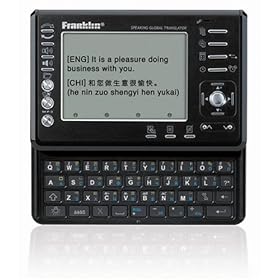
Franklin TG-490 Speaking Translator for the traveler in the house!

New Digital Camera - Always popular gift. I'm reviewing stats. Thought I would like to replace Fujifilm Finepix F30 with Finepix F50D but noise issue (as presented in review in DPReview) is concern for low light photography in museums. F50D also lacks image stabilization - my one main criticisim of the F30. Very impressed with colleague's Sony H7 camera performance in low light in Naples. I guess I'll need to think this over more.

Photoshop Elements software - VERY intuitive and featureful and available through techhead.org for a fraction of the price of its parent product. I've used Elements now for over six months and vastly prefer it to the full version of Photoshop. Only missing features involving CMYK for those doing press work. Also does not have Macro recording feature. I seldom used either of these features so I don't miss them.

Sunday, October 28, 2007

DNA Testing and Genealogy - A Dubious Match Made in Cyberspace??


Oh, dear. I read this article almost with a sense of disbelief but people can be quite revealing when it comes to their personal passions! After all of the "boogey man" stories about how nefarious government and corporate agencies (such as insurance companies) would use DNA databases to oppress and discriminate against members of society, people are willingly jumping on the DNA bandwagon in droves because of their passion for genealogy.

"As the internet became an every day tool for millions of people. it changed the way family historians do research. The availability of on-line, easily accessible genealogy and historical information has fueled the phenomenal growth of Genealogy as a hobby... Everywhere we look we see genealogy reported as the fastest growing hobby in the country. Now the internet is the first stop for beginning family historians and is used extensively by experienced researchers." - The USGenWeb Project.

New York Times excerpt: "Men can get a lot more out of DNA testing because they inherit both an X and a Y chromosome, enabling them to identify their paternal haplogroup and easily trace the history of paternal surnames. But women can only identify their maternal haplogroup, unless they use a sample from a close male relative like a brother or father. (Hey, Thanksgiving is coming up!)

Other sites — such as Nationalgeographic.com and Oxfordancestors.com — offer similar DNA tests that are a reliable way to reveal broad facts like, say, whether you have Native American or Asian ancestors. But scientists warn that it is best to shy away from sites that promise to pinpoint a specific region or country of origin, because in most cases the tests can’t uncover such specific details.

I chose Ancestry.com because it already has a user base of 15 million, more than 3 million of whom have posted their searchable family trees at the site. So I’m counting on the network effect.

The more Ancestry.com’s users who have their DNA tested, the more results there will be to compare to mine. Genetic matches will be posted on my results page — and then I will be able to e-mail like-minded historians to ask for more help solving the family-tree puzzle — so with luck I won’t have to be a detective alone for long.

Or, as Megan Smolenyak, a spokeswoman for Ancestry.com, explained it: “It’s basically a matchmaking game. You get a pile of numbers. I get a pile of numbers. And if they match, those people can become research buddies.”

For now, the database is small, comprising as of last week only 6,500 results from previous tests. So I didn’t really expect to find a long-lost cousin.

At this point, identifying one’s haplogroup, and thus your ancestors’ gradual migration, is the main benefit of the tests (which at Ancestry.com cost from $144 to $199)." - Marie Antoinette, Is That You? By MICHELLE SLATALLA.

I see Oxford Ancestry charges from $180 for a single maternal or paternal line analysis to $370 for ONE MatriLine™ analysis, ONE MatriMap™ print, ONE Y-Clan™ analysis and ONE PatriMap™ print. You can also order a smörgÃ¥sbord of other options including a "Tribes of Britain" analysis for an extra $25. Hmmm....this looks like it could generate some serious revenue!

National Geographic's "Genographic Project" offers participants a kit for $99.95 that includes:

• Buccal swab kit
• Multimedia DVD
• Exclusive National Geographic
Genographic Map

• "Quick Start" card
• Genographic Project Brochure
• Self-addressed envelope
• Confidential Genographic Project
ID Number (GPID)

However, National Geographic says their results are not genealogical in nature:

"We run ONE test per participation kit. We will test either your mitochondrial DNA, which is passed down each generation from mother to child and reveals your direct maternal ancestry; or your Y chromosome (males only), which is passed down from father to son and reveals your direct paternal ancestry. You choose which test you would like administered.

What to Expect
Your results will reveal your deep ancestry along a single line of direct descent (paternal or maternal) and show the migration paths they followed thousands of years ago. Your results will also place you on a particular branch of the human family tree. Some anthropological stories are more detailed than others, depending upon the lineage you belong to. For example, if you are of African descent, your results will show the initial movements of your ancestors on the African continent, but will not reflect most of the migrations that have occurred within the past 10,000 years. Your individual results may confirm your expectations of what you believe your deep ancestry to be, or you may be surprised to learn a new story about your genetic background.

You will not receive a percentage breakdown of your genetic background by ethnicity, race, or geographic origin. Nor will you receive confirmation of an association with a particular tribe or
ethnic group.

Furthermore, this is not a genealogy study. You will not learn about your great-grandparents or other recent relatives, and your DNA trail will not necessarily lead to your present-day location. Rather, your results will reveal the anthropological story of your direct maternal or paternal ancestors—where they lived and how they migrated around the world many thousands of years ago." - National Geographic Genographic Project.

However, they mention that as research progresses you may be able to obtain more detail:

"Remember, your initial results are just the beginning. They are based on current science and may become more detailed and refined as the ongoing field research yields new information. Be sure to visit this Web site often to follow along as we post new findings and automatically update your results."

National Geographic assigns an anonymous ID number to your record in the database to protect your privacy:

"To ensure the privacy of participants, we have built an anonymous analysis process. Your Participation Kit will be mailed with a randomly-generated, non-sequential Genographic Participant ID number (GPID). Although we will have mailed a Participation Kit to your address, we do not know the random code included in the Kit. When you send in your DNA sample with your consent form, they will only be identified by your GPID. Therefore, your cheek cells will be analyzed completely anonymously."

Since most of us working with database technologies know that somewhere there is usually a crosswalk file to match anonymous IDs with real user identification I wondered if this is true with the Genographic kit. Normally, if subsequent login access to a file is supported, this is the case. But, the Genographic Project has addressed this issue:

"
The kit contains a password for access to the Genographic Project participant web page. YOU MUST RETAIN THIS PASSWORD IN ORDER TO ACCESS YOUR GENETIC MIGRATORY PROFILE. To protect your privacy, National Geographic does not associate any personally identifiable information about you with this randomly assigned password, and if you lose this password we cannot recover it for you or provide you with any other means of accessing the results of your participation."

So, the only other issue would be if National Geographic could be compelled to track this information by some clandestine order of the NSA or other security agency given "special powers" by our current nosey regime.

However, Ancestry.com is not following any type of human subject protocol:

"Ancestry.com will not share your testing results with other organizations without your consent. In addition, as with all user submitted content Ancestry.com gives you control over your privacy settings that determine whether your information is public or anonymous."

In other words, they have a database connecting DNA results with individual user identification.

Oxford Ancestry's tracking system is similar: "
Oxford Ancestors will not use your DNA for any other purpose than for the services you have requested. Your results will be disclosed only to you, unless you specifically instruct us otherwise, and your DNA will be destroyed after your results have been despatched."

Family Tree DNA assigns a kit ID number but is obviously maintaining a crosswalk file between ID numbers and personal contact information:

"Family Tree DNA follows stringent policies for protecting your privacy according to state legislation guidelines. We control the Surname Database Library and genetic testing scores. Both the University of Arizona testing lab and our Genomics Research Center follow strict guidelines to ensure your privacy is maintained. Only limited information is shared with the testing facility.

Family Tree DNA accepts the responsibility to keep your specific data private, at the same time, making enough general information public to allow us to build a Surname Database library to be used for genealogical purposes."

They also offer participation in special projects that begins to share your data with others:

"Family Tree DNA also provides the option to participate in a group project in order to try to learn more by working with others who may share similar ancestry. If you choose to participate in a project the group administrator will be able to view your results and contact information so that he or she may best help members of the project learn about their ancestry. So that members can share information more easily a public website displaying member results is often created. The free website that Family Tree DNA provides to projects allows results to be listed by kit number, computer generated number, oldest known ancestor, or surname. It does not list personally identifying information. You may join or leave projects at any time after your results are posted at no charge. You can view a list of projects here.

Your unique test kit number will accompany your collection tube to the testing lab. The computer-generated number and your surname is the only information about you that the testing facility will see. Once your test has been completed the results of the Y-DNA or mtDNA test will be entered in a secure database. A comparison between your specific genetic results and those of others in the database will then be performed.

If a genetic match is found between you and another person in the database and you have each signed the release form you will be informed via email.

If a genetic match is found between you and another individual who enters the library at some time in the future, both will be given the information that a potential match is in the database provided that BOTH of you have signed the release form. Only if both parties agree will contact information concerning the separate parties be made available to the other party. In this way, all persons in the database will have the right to decide if they want to contact their genetic match(es).

Privacy and confidentiality will be strictly maintained." - Family Tree DNA.

From a security standpoint, two things jump out at me. The first is the reference to state legislation. We all know the federal government can and has trampled on state law at will. The second thing is the "release form". Obviously signing it begins to obviate the other security assurances.

I am beginning to sound like one of my more paranoid colleagues but I'm concerned that people will treat the provision of this very sensitive information as lightly as they treat signing up for an account on many other Web 2.0 social networking sites. If we didn't currently live under such an oppressive regime that has demonstrated its willingness to ignore personal rights to privacy I probably would be at least a little less nervous. But in the existing environment where both government and corporate espionage against our own people is sanctioned as "necessary for Homeland Security" I fear the worst use of this information will be made.

"Way back" in 1997, a movie was released entitled "Gattaca". Unfortunately, it passed through local theaters all too briefly. Perhaps it was released just a little before its time.

"Gattaca Corp. is an aerospace firm in the future. This future society analyzes your DNA at birth and, based upon your projected life expectancy and disease likelihood, determines where you will be assigned in the social order. Ethan Hawke's character, Vincent, conceived naturally without the accepted clinical "quality control", was born with a 95% chance of developing a heart condition - at least according to his DNA sequence - which has relegated him to the society's trash bin. These individuals are assigned menial tasks such as janitorial work that do not require the society's output of resources for education and training. His dream, however, is to explore space.

In desperation, Vincent dives into the world of a genetic black market, assuming the identity of Jerome (played by Jude Law), a physically spectacular athlete who has had the misfortune to be crippled in an accident. By using samples of Jerome's hair, skin, blood and urine, Vincent is accepted by the Gattaca Corporation and selected for a manned mission to Saturn. As Vincent trains for his lifelong dream assignment, he must constantly pass gene tests each day. He must avoid detection by meticulous hygiene to avoid leaving any of the thousands of cells our bodies shed each day behind at his worksite that could be picked up by corporate security sweeps. Then, one day, an errant eyelash escapes him, and it is found when a mission director is killed and police sweep the scene for evidence. Of course they are sure the miscreant who left the eyelash is the guilty party and to make matters worse, the investigative team is led by Vincent's genetically superior brother. As extra security measures are implemented in the search for the "impostor", Vincent's position becomes more and more precarious. I won't provide a spoiler. I would urge you to rent or buy the DVD to learn what happens to Vincent and his "perfect" world.


Thursday, October 04, 2007

Berkeley Offers Full Lectures on YouTube

UC Berkeley must have worked out an "iTunes-U" type of agreement with Google and is now featuring their lectures on YouTube. They must have been granted special provider status, though, to get around the current 10-minute video size limit. Anyone can upload larger videos to Google Video, but YouTube really has the name awareness and high traffic volume that is needed to ensure widespread exposure. What is particularly nice about having the lectures on YouTube as opposed to iTunes-U is that you can directly link the video files to other web resources or embed the video inside webpages. With iTunes, you can provide only a link to the Apple introductory site to iTunes-U where visitors click on a link to launch the iTunes Store to browse and find the videos.


"YouTube is now an important teaching tool at UC Berkeley.

The school announced on Wednesday that it has begun posting entire course lectures on the Web's No.1 video-sharing site.

Berkeley officials claimed in a statement that the university is the first to make full course lectures available on YouTube. The school said that over 300 hours of videotaped courses will be available at youtube.com/ucberkeley.

Berkeley said it will continue to expand the offering. The topics of study found on YouTube included chemistry, physics, biology and even a lecture on search-engine technology given in 2005 by Google cofounder Sergey Brin.

"UC Berkeley on YouTube will provide a public window into university life, academics, events and athletics, which will build on our rich tradition of open educational content for the larger community," said Christina Maslach, UC Berkeley's vice provost for undergraduate education in a statement."

Thursday, September 27, 2007

Crazy Talk promising animation tool for web apps

I’ve been having great fun with a new tool called Crazy Talk. It lets you create talking heads for your website that include automatic lip synching by just importing a .wav audio file. I have one on my web page. It does require installing a plugin but I read there is a way to automatically embed the player in the web page so installing a plugin is not necessary. I’m checking into it.:

http://uoregon.edu/~mharrsch

Here are some others I created:

http://uoregon.edu/~mharrsch/CrazyTalk/CrazyCleo.htm

http://uoregon.edu/~mharrsch/CrazyTalk/CrazyAntony.htm

A Talking Character can be created quite quickly. You simply import the image. Crop it. Then place indicators at the outside corner of each eye and outside corners of the lips. If you want to tweak the mouth shapes during lip synch there is a phoneme editor. You can also apply emotional animations. On the Marc Antony image, I applied an “angry” emotion.

The website where I got it is http://www.reallusion.com

I’ve also been working with their machinma software IClone. It’s quite impressive as well. I’ve created a couple of characters so far:

http://www.flickr.com/photos/44124324682@N01/sets/72157601884615693/

I created the Roman character in iClone using Ciaran Hind’s face (He played Caesar in HBO’s Rome). I used pictures of lorica segmentata I got from a reenactors’ supply website to create the armor using the costume design addin called “Clone Cloth”. The product not only lets you easily create figures with your own imported faces but can import motion capture files from other programs as well. I found a treasure trove of free motion capture files up on a website named bvh.com. iClone includes a BVH motion capture editor so you can match up the joints to the IClone avatars properly. Like Crazy Talk, the product also has a built-in automatic lip synch function so you just have to import a .Wav file and it automatically syncs the characters mouth and teeth to the words. It’s digital studio features are also quite impressive.

Here’s an iClone version of Act 2 scene 1 from Macbeth:

http://www.youtube.com/watch?v=r6K7PXf4nRI

You have complete control of the avatars and their movements, lighting, camera angle, atmospheric effects, etc. There is even a particle generator for fog, lightning, etc.

There’s over 100 iClone films on YouTube that you can find by simply searching for IClone.

Wednesday, September 19, 2007

Google promotes advertising widgets

Google is seizing on the popularity of widgets — small online tools that function like mini-Web sites — for its latest push into advertising.

An ad for Honda Civic was an example of Google’s widget program. Users can give the ad a ubiquitous presence on the Web.

The online giant will announce today a Gadget Ads program that will provide tools for advertisers to run widget ads in Google’s AdSense network.

Marketers can use space within these display ads on Google’s network to show videos, offer chats with celebrities, play host to games or other activities. If consumers like the widget ad, they can save it onto their desktops or on their profile pages online on sites like Facebook and MySpace.

The new widget ads represent a more aggressive push by Google to attract big brand advertisers who like flashy ad units rather than the simple text ads commonly run in Google’s ad network.

One big advantage of the technology is that the consumer does not have to click through to a Web site. A weather widget, for example, would constantly update the weather report in a particular area. Similarly, marketers could feature content to attract consumers while constantly updating their own messages.

More than 48 percent of Internet users in the United States — over 87 million people — now use widgets, according to comScore, the online measurement company. Some of the most popular widgets on Facebook, for example, are the “Top Friends” tool, which allows people to go to their best friends’ profiles with a single click, and iLike, which lets users add music to their profiles.

“Consumers are pulling in content from multiple sources” said Christian Oestlien, a business product manager at Google who is overseeing the new ad program. “It is what we are calling the componentization of the Web. The Web is sort of breaking apart into smaller pieces.”