Showing posts with label technology. Show all posts

Thursday, July 29, 2010

Pricey Elder Care Monitoring Systems Overlook Logic

As an aging baby boomer myself with medical issues that invariably accompany the aging process, I have found myself frequently annoyed at my own loss of short-term memory and its impact on trying to manage my own health care and the even more challenging task of overseeing the care of my husband, a disabled Vietnam veteran.  So I was instantly drawn to the article, "Technologies Help Adult Children Monitor Aging Parents", in the New York Times this morning.  But as I read the article and checked some of the related links, I couldn't help but be dismayed that so many companies are developing systems that are based around a pricey monthly subscription plan and the more complex systems rely on an expensive system of sensors throughout the elder person's home.

Although such systems are touted as far less expensive than a nursing home, they ignore the fact that most of the activities they monitor could be keyed to the daily activities that surround medication management for a lot less money.  

For example, the article talks about using motion sensors to tell if a person has gotten out of bed.  If the person's daily routine includes taking medications in the morning and the medications are in the bathroom or the kitchen, then the person has obviously gotten out of bed if they have taken their morning medications. 

One of the more elaborate systems costing in excess of $8,000 uses sensors on the refrigerator to track when the door is open or closed and for how long.  The apparent assumption is that if the door is open for more than a few seconds, the person has gotten enough food out of it to indicate they have prepared a meal.  A much more reliable indicator would be to use blood glucose levels, whether a person is diabetic or not, and weight.  Both of these activities could be incorporated into the morning medication routine.


As for using motion sensors to track whether the person is moving around the house, how do those systems distinguish between the resident and their pet(s)?  The article mentioned the case of a man becoming panicked because his mother's motion sensors showed a flurry of activity in the sun room.  She had decided to paint the room and was happily redecorating when he called her.  When I examine my own activities during the day as a retired person, I find that, although I have somewhat of a daily routine, my activity levels often vary based on the weather, the time of year, unscheduled visits of friends and family or weekly or seasonal errands.  This morning, for example, I went outside to do yard work early in the morning because it is supposed to be pretty warm later in the day.  In the winter, however, I may sleep in a little longer.  If I've worked hard out in the yard I may decide to take an extended nap after lunch and motion sensors would not track much movement at all although I am perfectly fine.  So I think minute by minute tracking of a person's daily movements is overkill in my opinion.  


Of course such precise monitoring and reporting via email, text message or phone call is the justification these companies are using to charge their monthly monitoring fee.  But we all know that we don't really want to know all the times things are within normal parameters.  We only really want to know when something is wrong.  


The really promising device mentioned in the article was the computerized Med Minder, lovingly called "Maya", produced by Med Minder Systems, Inc..  It resembles a large weekly medication dispenser with a power cord that has a computerized monitoring system incorporated into it. The device is wireless like a cell phone and can transmit a host of reminders to family or caregivers via phone, email or text message:

  • Medication was not taken on schedule
  • Medication cup was taken out at the wrong time
  • Medication cup was not returned to the compartment
  • Scheduled refill has started
  • Refill was started, but not finished
  • Unscheduled refill occurred
  • MedMinder tray was not replaced during the refill
  • Reminder to take medication
  • Reminder to refill the box
  • Scheduled refill was missed
  • Pillbox registration failed
  • Pillbox was deregistered
  • Loss of wireless connection
  • Wireless connection reestablished
  • Pillbox turned on
  • Pillbox lost power and is running on battery
  • Pillbox power restored
  • Pillbox shut down
As many older people have problems with vision or hearing loss, Maya's alerts include both visual and auditory signals.


"Maya provides alerts that are both visual and auditory. The beeps can be easily heard and the lights flash on & off to get your attention. The system also provides automatic phone calls as reminders, in case the lights and beeps do not prompt taking the scheduled medication. You can also choose to receive just some of the reminders and disable the others. If you are visually impaired, the unit opens easily and the cups and compartments are large enough to feel and easy to remove and replace." - Med Minder website


For the technology the device uses, it's hardware price of $147 is actually pretty reasonable.  However, it also requires a $19 per month subscription fee.  This fee is not exorbitant but for elderly patients with a computer system and a DSL wireless router, I think the device should be configurable to use an existing wireless network instead to eliminate the monthly subscription fee.  


If the device were combined with a wireless enabled digital scale, a wireless blood glucose monitor, a wireless blood pressure cuff, and software that can be configured for individual normal parameters and only emails family and caregivers if daily readings vary by a specified degree, I think many seniors would welcome it without concerns about control and privacy.  Such a system could probably be produced for less than $500 and still give the manufacturer a decent profit.   It could also be expandable to include add-ons like a wireless CPAP machine interface, wireless exercise bike or treadmill, an interface to a Wii or a smart card interface. 

Many grocery stores have incorporated buyer "preferred" cards that they scan along with your debit card when you buy groceries so they can offer you more targeted coupons (and probably sell your preferences to corporate marketers).  Just think of the nutritional information that is available by simply having software analyze the weekly grocery purchases.  In fact, a good nutritional analysis program could also make recommendations for more nutritious alternatives which I'm sure many seniors, including me, would welcome.


Elder Care Made Easier: Doctor Marion's 10 Steps to Help You Care for an Aging Loved One

Wednesday, January 21, 2009

History Channel special to bring Lincoln virtually to life


This year is the 200th anniversary of the birth of Abraham Lincoln. In commemoration, The History Channel will be broadcasting a special, "Stealing Lincoln's Body" beginning February 16 at 9 p.m. EST. Many of us are aware of the thwarted attempts to steal and ransom Lincoln's corpse after it was delivered to Springfield, Illinois for burial, but, what caught my attention about this program is it's use of new visual graphics technology to present reenactments using photographs of Lincoln himself, not costumed actors.

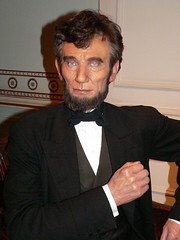
[image - Abraham Lincoln at Madame Tussaud's in London, England]

"...the program features moving images of Abraham Lincoln, digitally created from actual historical photographs. For the first time, Lincoln walks and moves according to the historical record. The moving images and some of the stills showcase the first “virtual photography” of Lincoln and the only “virtual motion” pictures of him ever created. Using computer-generated imagery, it illustrates key sections of the story and brings them to life, often with startling effect.

These new photographs and moving images of Lincoln highlight a level of historical detail and information never seen before. Ray Downing of Studio Macbeth, who created these digital effects for STEALING LINCOLN’S BODY, explains the technique began as a kind of experiment using contemporary film technology. It gives the modern audience an opportunity to “gaze upon the noble face of our most beloved president, to see him walk down the street, to see him alive again…. Today’s technology allows us to achieve a level of photographic realism previously unattainable, with the added bonus of motion graphics."


Author and Lincoln scholar Harold Holzer , who is interviewed in STEALING LINCOLN’S BODY, says: The result—an uncanny, believable, realistic, living Lincoln—moving before our eyes as he must have in life, wholly imagined yet based on actual photos—took my breath away. Here is the man who lived, laughed, spoke, walked, for precious seconds practically born again.”


Here's a YouTube preview. Pay particular attention to the first few seconds - the animation is seamless!!


I have worked with a product called CrazyTalk by Reallusion to animate the faces of still images of sculptures of people from long ago and this Christmas I even used it to create an animation of my late father calling one last square dance for my other family members as a OOAK Christmas gift. I'm presently working on a project to combine such animation with artificial intelligence to enable website visitors to virtually "talk" to historical personalities using the historical sculptures of George Stuart.


So I am anxious to see how similar software can be used to create full length animation and virtual photographic reenactment.


The program's focus:


"After lying in state at the White House and at the Capitol (the nation’s first presidential state funeral), Lincoln’s body was carried by train in a grand funeral procession through several states and nearly two thousand miles, arriving in his hometown of Springfield, Illinois on May 4. However, his final burial would not take place until 1901, thirty six years later.

Before Lincoln finally came to rest in a steel-and-concrete-reinforced underground vault in Springfield , the President’s body was repeatedly exhumed and moved, his coffin frequently opened.

In 1876, 11 years after Lincoln 's assassination, a band of Chicago counterfeiters devised a fantastic plot to steal Lincoln ’s body and hold it for ransom. They wanted $200,000 and the release of the gang's master engraver who was in prison in Illinois . The Secret Service – recently formed to deal with the country's ballooning counterfeiting problem – infiltrated the gang with an informer. Yet it also set in motion a cringe-inducing chain of events in which a group of well-intentioned, self-appointed guardians took it upon themselves to protect Lincoln ’s remains by any means necessary.

Some efforts to protect the remains of the 16th President of the United States would prove to be equally misguided and macabre. Finally, in 1901, thirty six years after Lincoln ’s assassination, Robert Todd Lincoln had the body of his father interred in a massive concrete vault. The contrast between the nation’s reverence for Abraham Lincoln and the shocking manner in which his body had been treated is striking. This strange story of Lincoln at un-rest reveals how important this man was to so many, and perhaps our reluctance to let such a beloved and visionary leader go."


Teacher and student contests, original short form video about Lincoln ’s life and Presidency, related lesson plans, as well as instructions for how to donate to this campaign will be available online at www.history.com/lincoln .


STEALING LINCOLN’S BODY was produced for The HISTORY Channel by Left/Right. Productions.

Tuesday, January 06, 2009

House calls via webcam a step in the right direction

At last someone is taking virtual medical services seriously on a statewide scale. The article says insured patients pay $10 - they must mean $10 per virtual session.

I have read that some doctors now offer email contact to some patients too. I've been trying to get my doctor to do that for years but she doesn't want to communicate that much. Perhaps if doctors would subscribe to a secure Twitter-like service that would enable patients to post health updates like a running dialogue it would give doctors more insight into how their patients are actually doing on a regular basis instead of just seeing patients when they have a health crisis. Doctors or their assistants could scan the dialogues periodically and if they see a troubling pattern starting to emerge they could then proactively contact the patient before a crisis arises.

American Well, a Web service that puts patients face-to-face with doctors online, will be introduced in Hawaii on Jan 15.

Its first customer, Hawaii Medical Service Association, the state’s Blue Cross-Blue Shield licensee, will make the Internet version of the house call available to everyone in the state, the company said.

The service is for people who seek easier access to physicians because they are uninsured or do not want to wait for an appointment or spend time driving to a clinic, said Roy Schoenberg, co-founder and chief executive of American Well Systems, which is based in Boston.

Dr. Schoenberg, a physician, said that American Well had piqued the interest of policy makers in Washington who want to expand access to health care. Insurers in other states will soon offer the service, he said.

Patients use the service by logging on to participating health plans’ Web sites. Doctors hold 10-minute appointments, which can be extended for a fee, and can file prescriptions and view patients’ medical histories through the system. American Well is working with HealthVault, Microsoft’s electronic medical records service, and ActiveHealth Management, a subsidiary of Aetna, which scans patients’ medical history for gaps in their previous care and alerts doctors during their American Well appointment.

The Hawaiian health plan’s 700,000 members pay $10 to use the service. The insurer also offers the service to uninsured patients for $45. Health plans pay American Well a license fee per member and a transaction fee of about $2 each time a patient sees a doctor.

Wednesday, December 03, 2008

Why are female Computer Science majors declining?

As someone who has been a rather "rare" female technology professional for over twenty years, I read this article by Professor Randall Stross with interest. Afterwards, I wrote to him to point out something I don't think the article considered, at least, not directly:

Professor Stross, I sometimes think that the reason women are not drawn to a computer science degree is that the discipline deals primarily with the computer as a machine, not as a tool that can be used creatively to solve human problems, enhance human communication, and enrich human lives.

Here is the definition of our Computer Science major from the University of Oregon’s own course catalog:

“Computer science is the study of the computer as a machine, both concrete and abstract; it is the study of the management of information; and it involves the design and analysis of algorithms, programs, systems, and programming languages.”

There is not even a whisper of how the machine is used in a human social context.

Women are still given the primary role of nurturers by our culture and are socialized throughout their education with that overriding expectation. The religious fundamentalism that has dominated society in many parts of the country over the last eight years has further emphasized this cultural stereotype. So it is not surprising that the vast majority of women would find a discipline that approaches computer science as primarily the study of an inhuman machine to be less than satisfying.

Anyway, here's an abstract from the original article.

Jonathan Kane, a professor of mathematics and computer science at the University of Wisconsin-Whitewater, recalls the mid-1980s, when women made up 40 percent of the students who majored in management computer systems, the second most popular major on campus. But soon after, the number of students majoring in the program had fallen about 75 percent, reflecting a nationwide trend, and the number of women fell even more. “I asked at a department meeting,” he says, “ ‘Where have the women gone?’ It wasn’t clear.” His theory is that young women earlier had felt comfortable pursing the major because the male subculture of action gaming had yet to appear.

Justine Cassell, director of Northwestern University’s Center for Technology & Social Behavior, has written about the efforts in the 1990s to create computer games that would appeal to girls and, ultimately, increase the representation of women in computer science. In commenting as a co-contributor in a new book, “Beyond Barbie and Mortal Kombat: New Perspectives on Gender and Gaming,” Ms. Cassell writes of the failure of these efforts, “The girls game movement failed to dislodge the sense among both boys and girls that computers were ‘boys’ toys’ and that true girls didn’t play with computers.”

She said last week that some people in the field still believed that the answer to reversing declining enrollment was building the right game. Another school of thought is what she calls the “we won” claim because women have entered computer-related fields like Web site design that are not traditional computer science. Ms. Cassell points out that it’s not much of a victory, however. The pay is considerably less than in software engineering and the work has less influence on how computers are used, and whether this actually accounts for the diminishing numbers of female computer science majors remains unproved. - More (NY Times)

Tuesday, August 19, 2008

Project-based learning not particularly new

The snail's pace that education uses to transform the learning process with technology never ceases to amaze me. This week an article in the New York Times touts technology-supported "project-based learning" as the new "silver bullet" that will finally revolutionize education. "Project-based learning has been around for decades. The only thing technology really adds to the process is collaborative support through a social networking portal. Once again, the computer's true strength, simulation, is left out of the equation.

The project example given is designed around a letter from the White House bemoaning high oil prices, a faltering economy, and falling popularity polls:

"The new Web education networks can open the door to broader changes. Parents become more engaged because they can monitor their children’s attendance, punctuality, homework and performance, and can get tips for helping them at home. Teachers can share methods, lesson plans and online curriculum materials.

In the classroom, the emphasis can shift to project-based learning, a real break with the textbook-and-lecture model of education. In a high school class, a project might begin with a hypothetical letter from the White House that says oil prices are spiking, the economy is faltering and the president’s poll numbers are falling. The assignment would be to devise a new energy policy in two weeks. The shared Web space for the project, for example, would include the White House letter, the sources the students must consult, their work plan and timetable, assignments for each student, the assessment criteria for their grades and, eventually, the paper the team delivers. Oral presentations would be required."

But where is the program that can take solutions offered by the students and project the historical outcomes - the fertile soil in which many fruitful discussions can take root?

Wednesday, June 04, 2008

Bigger Computer Monitors = More Productivity

Apparently using a 24" monitor makes me more productive not just indulgent!

"Researchers at the University of Utah tested how quickly people performed tasks like editing a document and copying numbers between spreadsheets while using different computer configurations: one with an 18-inch monitor, one with a 24-inch monitor and with two 20-inch monitors. Their finding: People using the 24-inch screen completed the tasks 52% faster than people who used the 18-inch monitor; people who used the two 20-inch monitors were 44% faster than those with the 18-inch ones. There is an upper limit, however: Productivity dropped off again when people used a 26-inch screen. (The order of the tasks and the order of computer configurations were assigned randomly.)

The study concluded that someone using a larger monitor could save 2.5 hours a day. But James Anderson, the professor in charge of the study, tells the Business Technology Blog to take that result with a grain of salt: It assumes that someone will work non-stop for eight hours, which no one will, and that the tasks they perform will all benefit from a larger screen, which isnt always the case. But things like moving data between files are ideally suited to bigger or multiple screens. Anderson, who uses a computer with two 20-inch screens and one 24-inch one, recommends that businesses take the time to match employees with the proper size screen based on job requirements.

A caveat: The study was funded by NEC, which makes computer monitors. But Anderson says that it was vetted by the Universitys research board. Also, he doesnt care who businesses buy their monitors from he just wants businesses to realize that the right monitor can make someone more productive. And if a tech department has to buy 500 of the same size in order to get a bulk discount? Buy the biggest ones you can, Anderson tells us. Size matters, he adds." - Originally posted by Ben Worthen

Sunday, March 09, 2008

Text Generation Gap - R We Really 2 Old?

This article in the New York Times confirmed what I have personally observed about technology use by teens for some time. As an older boomer who is not digitally challenged, however, I cannot help but think some of these developments are disturbing. I recoil at the thought of how much bandwidth is wasted every day by teens and even many adults who somehow think their every thought is worth sharing with someone. The NSA must get really tired of trying to sift through so much drivel looking for suspicious communications. I also find it irritating that today's youth arrogantly stereotype all older adults as "clueless" when many of us are the ones who actually developed the technology they are so blithely using. I guess most of all I wish people would use this technology for more meaningful applications. I'm glad some families think cellphone use keeps them in closer communication with each other but I can't help but wonder if their virtual lives based on these shallow exchanges are supplanting the more intimate relationships that develop with face-to-face conversations.

"Children increasingly rely on personal technological devices like cellphones to define themselves and create social circles apart from their families, changing the way they communicate with their parents.

Innovation, of course, has always spurred broad societal changes. As telephones became ubiquitous in the last century, users — adults and teenagers alike — found a form of privacy and easy communication unknown to Alexander Graham Bell or his daughters.

The automobile ultimately shuttled in an era when teenagers could go on dates far from watchful chaperones. And the computer, along with the Internet, has given even very young children virtual lives distinctly separate from those of their parents and siblings.

Business analysts and other researchers expect the popularity of the cellphone — along with the mobility and intimacy it affords — to further exploit and accelerate these trends. By 2010, 81 percent of Americans ages 5 to 24 will own a cellphone, up from 53 percent in 2005, according to IDC, a research company in Framingham, Mass., that tracks technology and consumer research.

Social psychologists like Sherry Turkle, a professor at the Massachusetts Institute of Technology who has studied the social impact of mobile communications, say these trends are likely to continue as cellphones morph into mini hand-held computers, social networking devices and pint-size movie screens.

“For kids it has become an identity-shaping and psyche-changing object,” Ms. Turkle said. “No one creates a new technology really understanding how it will be used or how it can change a society.”

Thursday, August 02, 2007

Why Twitter?

A couple of times this week I have encountered references to a new "social community" called Twitter. I see it is even on the board for discussion at the Educause ELI conference in San Antonio in January. So I decided I better go up and see what all the fuss is about.

Perhaps I'm not seeing the big picture here, but it looks like Twitter is designed for those people who must give everyone around them a blow by blow account of their life whether we're interested or not. It reminds me of people with cell phones stuck to their ears in restaurants and grocery stores describing the latest produce to anyone in their calling circle that will listen.

Twitter says its like a mini-blog (posts are limited to 140 characters) but looking at the statements being shared by users of Twitter, I'd have to say I've got better things to do with my time than try to plow through all that drivel looking for something that I may find interesting or useful. Maybe people who have scanners to monitor police and emergency services communications would love it. I see the LA Fire Department posts their response calls to a Twitter account.

I went up and read the official Twitter blog to try to identify the element that would make their service useful or compelling and I'm still at a loss for grasping the potential of their idea. Furthermore, I notice that they attracted venture capital but for the life of me I don't know how they could make a "venture capital level" of ROI with no discernible business model.

I must not be alone in my assessment of Twitter's potential. The Wall Street Journal wrote, "These social-networking services elicit mixed feelings in the technology-savvy people who have been their early adopters. Fans say they are a good way to keep in touch with busy friends. But some users are starting to feel 'too' connected, as they grapple with check-in messages at odd hours, higher cellphone bills and the need to tell acquaintances to stop announcing what they're having for dinner."[3]