Well, in one last swing at me, the National Portrait Gallery fired off an invoice to the University for the four images I am using on my historical doll website. Of course, I would not authorize payment so I had to forward the invoice to the General Counsel's office. Unfortunately, the General Counsel would not commit time to refute their claim because of the relatively (to them) small amount of money involved. They told me to remove the pictures in question and instructed the Computing Center to disable my website if I did not cooperate. Talk about strong armed tactics!
I find the whole episode very disturbing because essentially, it means that as long as there are institutions out there willing to ignore court rulings and make extortinate demands for copyright they do not hold and other institutions who are unwilling to challenge them, the extortion involving use of public domain works will continue!
Wednesday, November 23, 2005


Thursday, November 17, 2005
The Pen Gets a Whole Lot Mightier

New York Times: I found this article particularly interesting because several years ago I purchased a "smart" pen scanner to evaluate and found that it was much more difficult to produce accurate results with it than the demonstrator at Comdex displayed. Supposedly it was designed to allow you to easily scan article snippets and business cards into your PDA or laptop but I found negotiating the tiny menu with button clicks far too slow and frustrating to be efficient enough to recommend to my colleagues.
Apparently, the reviewer of this "pentop" also expressed a little irritation about navigating its menu as well although it is at least audio-enabled. There was no mention of speech recognition. It would be really nice if, when listening to the audio menu, you could reply "yes" when it gets to the option you want. Perhaps that will come with future enhancements. I was intrigued by the interactive testing and math studies applications though.
"The Fly Pentop Computer, made for children ages 8 to 14, is essentially a computer in a pen, with a computer chip, a speaker and a tiny camera. But Fly's maker, LeapFrog (maker of LeapPad, the popular interactive book reader), has much greater ambitions.
Fly Through Math, for example, is dedicated to multiplication and division. You write the digits of a math problem into the squares of the included graph paper. Like a watchful parent or teacher, the Fly's little voice-over elf comments immediately when, for example, you forget to carry the 1 or misplace a decimal point. This in-problem feedback is far more helpful than a computer program that just tells you that your final answer is wrong.
Then there's Fly Through Tests. From a Web site (flypentop.com), your sixth- through eighth-grader can download multiple-choice quizzes in PDF format that correspond to the chapters of specific popular published textbooks (math, science or social studies). You print them onto the blank paper that comes with this cartridge, and voilà: instant interactive tests, specific to the textbook you're using in class."
Friday, November 04, 2005
Wild Earth game looks to combine natural studies with photography skill development

I was checking for game updates to post to my web log about games with historical themes and I came across a new offering from European developer Digital Jester called "Wild Earth" that is scheduled for a Q1 2006 release.
"Featuring breathtaking landscapes from the African Serengeti National Park, Wild Earth is a stunning adventure which allows players to experience the African wildlife in its natural environment.
Players embark on various assignments, each of which feature different photographic objectives, challenging the player to explore the lush 3D world and take the best photographs of animals and environmental features.
At the end of each assignment, an html article is created using the player’s own photographs which provides additional in-depth information and insight. These articles can be printed, saved or shared.
Features
* Accurate and beautifully recreated wildlife including elephants, cheetahs, lions, crocodiles and more.
* Simulated weather conditions – (racing clouds, rainfall, dust devils, thunder storms).
* Immersive 3D environments (open plains, rocky outcrops, lakes, streams etc).
* Diverse missions including specific night-time challenges, wild animal tracking and exploration of the Serengeti terrain.
* Stirring soundtrack created by world music label Talking Drum Records.
* Creative game design; players are encouraged to practice and develop photography skills.
* Differing skill levels for more advanced photography challenges.
* Personalised gameplay utilising players photographs in html articles.
* Non-violent family oriented gameplay mechanic."
This game reminds me very much of one of my first and favorite simulation games that got me hooked on the genre, Eco: East Africa. This new take on the wildlife theme incorporates learning photography as well as learning about the natural world (two of my favorite things) and stands a very good chance of demonstrating how video games can be effective learning tools and cross-discipline to boot.
Thursday, October 27, 2005
Now Playing: Your Home Video (New York Times)
It looks like more entrepreneurs are jumping on the video sharing site bandwagon. I checked out Google Video and OurMedia. OurMedia appears to have features similar to Flickr. For educational purposes these sites would make it possible to create an online repository for screen-captured help files and learning objects that included video or animation converted to video.
"The entrepreneurs who have started companies like ClipShack, Vimeo, YouTube and Blip.tv are betting that as consumers discover the video abilities built into their cellphones and digital still cameras, and get better at editing the often-lengthy video from their camcorders, they will be eager to share video on the Web. While most of the services are free today, the entrepreneurs eventually hope to make money by selling ads or charging fees for premium levels of service.
Sharing video on the Web is still a new notion. 'A lot of people haven't really come to terms with the idea that they can publish their own video online,' said Jakob Lodwick, the founder of Vimeo, based in Manhattan. 'For the longest time, video has always been connected to a physical tape or a disc. There are still a lot of people who aren't even comfortable sharing their photos online yet.'
But many early users of video-sharing services have encountered frustrations with other means of distribution. Ms. Tallent, who lives in Marina del Rey, Calif., said she had tried posting videos directly on her personal Web site, but that was cumbersome, and she ran afoul of her Internet provider's limits on file size.
Paul Krikler, who works for an investment bank in Manhattan, got tired of creating DVD's for his family members so they could enjoy videos of Mr. Krikler's 10-month-old son, Benjamin, chortling at the camera or being fed.
'Making DVD's would've been a less frequent process,' Mr. Krikler said. Using ClipShack, 'I can put up a couple new clips on a Saturday or Sunday every week, and people can go in and see new clips on a Monday.'
Mr. Krikler chooses to allow only his circle of friends and family to view his videos, and says there are about 50 people in that group, including one friend in Australia. He shoots the videos using a digital camera from Canon that is designed mainly to to take still pictures, and sends the videos to ClipShack.
Users of the services can upload cin�ma v�rit�directly from the camera, or painstakingly edit the videos using software like iMovie from Apple or Windows Movie Maker from Microsoft. Some services, like Phanfare, charge a monthly fee, and most, with the exception of Google Video, limit the size of videos.
None of the sites should be considered a reliable sole archive for personal video, however, since many do not allow users to download their original file once it has been uploaded. And there is always the possibility that a site may vanish overnight.
At least two sites, Blip.tv and OurMedia.org, promise more permanence by uploading a copy of each video submitted to the Internet Archive, which is run by a San Francisco nonprofit organization whose mission is long-term preservation of digital material. "
"The entrepreneurs who have started companies like ClipShack, Vimeo, YouTube and Blip.tv are betting that as consumers discover the video abilities built into their cellphones and digital still cameras, and get better at editing the often-lengthy video from their camcorders, they will be eager to share video on the Web. While most of the services are free today, the entrepreneurs eventually hope to make money by selling ads or charging fees for premium levels of service.
Sharing video on the Web is still a new notion. 'A lot of people haven't really come to terms with the idea that they can publish their own video online,' said Jakob Lodwick, the founder of Vimeo, based in Manhattan. 'For the longest time, video has always been connected to a physical tape or a disc. There are still a lot of people who aren't even comfortable sharing their photos online yet.'
But many early users of video-sharing services have encountered frustrations with other means of distribution. Ms. Tallent, who lives in Marina del Rey, Calif., said she had tried posting videos directly on her personal Web site, but that was cumbersome, and she ran afoul of her Internet provider's limits on file size.
Paul Krikler, who works for an investment bank in Manhattan, got tired of creating DVD's for his family members so they could enjoy videos of Mr. Krikler's 10-month-old son, Benjamin, chortling at the camera or being fed.
'Making DVD's would've been a less frequent process,' Mr. Krikler said. Using ClipShack, 'I can put up a couple new clips on a Saturday or Sunday every week, and people can go in and see new clips on a Monday.'
Mr. Krikler chooses to allow only his circle of friends and family to view his videos, and says there are about 50 people in that group, including one friend in Australia. He shoots the videos using a digital camera from Canon that is designed mainly to to take still pictures, and sends the videos to ClipShack.
Users of the services can upload cin�ma v�rit�directly from the camera, or painstakingly edit the videos using software like iMovie from Apple or Windows Movie Maker from Microsoft. Some services, like Phanfare, charge a monthly fee, and most, with the exception of Google Video, limit the size of videos.
None of the sites should be considered a reliable sole archive for personal video, however, since many do not allow users to download their original file once it has been uploaded. And there is always the possibility that a site may vanish overnight.
At least two sites, Blip.tv and OurMedia.org, promise more permanence by uploading a copy of each video submitted to the Internet Archive, which is run by a San Francisco nonprofit organization whose mission is long-term preservation of digital material. "
Monday, October 24, 2005
'King Kong' Blurs Line Between Films and Games
New York Times: "Video games are among the fastest-growing, most-profitable businesses in the entertainment world. In the United States, domestic sales of video games and consoles generated $10 billion in revenue last year, compared with movie ticket sales of $9.4 billion. But with the exception of a few well-known directors - like George Lucas, who created a series of Star Wars video games, and Andy and Larry Wachowski, who wrote and directed 'The Matrix' movies and helped create Matrix games - few in Hollywood have been able to successfully operate in both worlds.
But that seems to be changing. Peter Jackson (The Lord of the Rings trilogy) is among a generation of mainstream movie directors who grew up playing video games. He, and a few others, are now looking to create video games, branding themselves to keep control over franchises while sharing in enormous video game profits.
Having recently completed shooting on a remake of the classic film "King Kong", Jackson wanted to create a video game that allowed players to experience a universe he created that otherwise would be confined to a two-hour movie."
I have great expectations for these kinds of technology "marriages". Years ago I wrote to some game companies suggesting that their technology could be used to create dynamic learning environments and all I got back in reply was a curt "we're in the entertainment business not the education business". Perhaps this imposed segregation was the result of the game industry's reliance on programmers that understood computer logic but lacked the artistic experience needed to produce compelling narrative or cinematic storytelling along with the flash and dash of CGI wizardry.
But that seems to be changing. Peter Jackson (The Lord of the Rings trilogy) is among a generation of mainstream movie directors who grew up playing video games. He, and a few others, are now looking to create video games, branding themselves to keep control over franchises while sharing in enormous video game profits.
Having recently completed shooting on a remake of the classic film "King Kong", Jackson wanted to create a video game that allowed players to experience a universe he created that otherwise would be confined to a two-hour movie."
I have great expectations for these kinds of technology "marriages". Years ago I wrote to some game companies suggesting that their technology could be used to create dynamic learning environments and all I got back in reply was a curt "we're in the entertainment business not the education business". Perhaps this imposed segregation was the result of the game industry's reliance on programmers that understood computer logic but lacked the artistic experience needed to produce compelling narrative or cinematic storytelling along with the flash and dash of CGI wizardry.
Once It Was Direct to Video, Now It's Direct to the Web
"As cheaper technology and a seemingly inexhaustible hipness quotient have led to more filmmakers and films being produced, theatrical distribution has become more expensive, the outlets more cautious, and the returns on investments more dubious. The Internet has absorbed some of the spillover, although the bigger success stories - notably, the political films of Robert Greenwald ('Uncovered: The War on Iraq,' 'Outfoxed: Rupert Murdoch's War on Journalism'), or 'Faster,' a highly lucrative motorcycle documentary narrated by Ewan McGregor - have been niche movies with a core audience.
So what about more general fare with no stars, budgets or hope? That's where IndieFlix, founded by Ms. Andreen and her business partner, the filmmaker Gian-Carlo Scandiuzzi, comes in. Directors submit their films, which are then posted on the Web site (www.indieflix.com). When users log on and click to buy the films that capture their interest, IndieFlix burns them onto a DVD and ships them out. The price for a feature-length film is $9.95."
I find this trend in film distribution to be a natural evolution of the industry, much in the same way as the online distribution of e-books developed to bypass the traditional, creativity-throttling publishing industry. I guess time will tell if we are able to coax some really interesting work out of new filmmakers with this strategy.
So what about more general fare with no stars, budgets or hope? That's where IndieFlix, founded by Ms. Andreen and her business partner, the filmmaker Gian-Carlo Scandiuzzi, comes in. Directors submit their films, which are then posted on the Web site (www.indieflix.com). When users log on and click to buy the films that capture their interest, IndieFlix burns them onto a DVD and ships them out. The price for a feature-length film is $9.95."
I find this trend in film distribution to be a natural evolution of the industry, much in the same way as the online distribution of e-books developed to bypass the traditional, creativity-throttling publishing industry. I guess time will tell if we are able to coax some really interesting work out of new filmmakers with this strategy.
Thursday, October 20, 2005
Copyright Wars
This past week I inadvertently became embroiled in a copyright dispute with the National Portrait Gallery in London. Several years ago I created a website about my historical doll collection and the history behind the dolls and the historical figures they represent. One of my site pages features pictures of Queen Elizabeth I and dolls that have been created to represent her. On that page is composited pictures of Queen Elizabeth dolls with historical portraits of the Virgin Queen painted in the 16th century. Because of the age of the portraits of Elizabeth, I was not concerned about copyright because such works are solidly in the public domain.
Well, I got an e-mail from the image librarian of the National Portrait Gallery last week insisting that I was in violation of copyright because they had the portrait in their collection and they do not let anyone else take photographs of it so I must have gotten the portrait illegally from their website. They asked where I got the image. With several years in between now and when I created the website I couldn't remember but being a work in the public domain I was certain it really didn't matter. I had been to copyright workshops and had been told that the U. S. courts do not recognize a simple reproduction (termed a "slavish" copy) of a two-dimensional work of art as copyrightable. This view was recently reinforced with the ruling issued in the BRIDGEMAN ART LIBRARY, LTD. v. COREL CORP. case.
I consulted our university copyright expert and she said my understanding of the law was consistent with prevailing interpretation. So I responded thus:
Well, I got an e-mail from the image librarian of the National Portrait Gallery last week insisting that I was in violation of copyright because they had the portrait in their collection and they do not let anyone else take photographs of it so I must have gotten the portrait illegally from their website. They asked where I got the image. With several years in between now and when I created the website I couldn't remember but being a work in the public domain I was certain it really didn't matter. I had been to copyright workshops and had been told that the U. S. courts do not recognize a simple reproduction (termed a "slavish" copy) of a two-dimensional work of art as copyrightable. This view was recently reinforced with the ruling issued in the BRIDGEMAN ART LIBRARY, LTD. v. COREL CORP. case.
I consulted our university copyright expert and she said my understanding of the law was consistent with prevailing interpretation. So I responded thus:
"I would like to respectfully point out that most of these portraits were created during the reign of the monarch depicted and therefore copyright has expired long ago. U.S. courts have ruled that a simple reproduction of a work that adds no artistic elements to the original work is not an enforceable capyright because subsequent reproductions could not be distinguished from any others. Possession of a work of art does not confer any copyright privileges to the owner. Unfortunately, this is a main point of contention between museums in particular, and other members of the public.
I would also like to point out that my website is not a commercial site. It is intended for educational purposes only and the derivative images that I created are small and low resolution and not injurious to the profitability of purveyors offering products featuring high quality reproductions. I did not obtain the images from your website and have used them in good faith under my understanding of U.S. copyright laws and the provisions for fair use. I would be happy to include a link to your website to encourage visitors to my site to learn more about British Royalty."
The librarian was undeterred, insisting:
"At present, UK and US copyright law does afford copyright to photographs taken of works that are out of copyright, although I am aware of the Bridgeman v Corel case to which you are referring and which in many experts' opinions reached the wrong decision (it is certainly not binding in the UK, and doubtful even in the US). In any case it has set no precedent. " (I found this comment a little odd. He is esstentially saying a case that has received a ruling by the U.S. Supreme Court is not binding in the U.S. and sets no precedent ???)
He went on to explain how the gallery's financial resources are limited and that it is expensive to provide images of their collection online for the public to view. He attached a license agreement with the expectation that I would sign it and pay the fees stated.
I replied:
"Although I am a faculty member at the University of Oregon, the website in question was one that I created with my own resources on my own time at home because of my personal interest in history and collecting historical dolls. The site was not produced to support a fee-based or tuition-based course and the University has no claim to copyright for the material included in it. My footer reference providing permission for free use of any of the materials on the site for educational purposes is granting permission for use of my own copyrighted works. The image composites I produced for this site have an obvious artistic element that is substantially different from the original work especially since the doll photographs are my own. I am well aware of the time involved and costs of creating an online image archive as you can see from my own photo archive (see the link below) that contains almost 6,000 of my originial images. I hope you also note that I have granted permission for all visitors to use any of my images in the collection for non-commercial educational purposes through a Creative Commons license. I think the problem here is the apparent difference in our philosophical approach to knowledge sharing. I would think it would be far more advantageous to you to have visitors driven to your site for further information and an opportunity to view the original works in a quality high-resolution format and possibly generate a desire to physically visit your museum or purchase some of your museum-based products than it is to try to limit the non-commercial use and appreciation of art that is essentially part of our collective heritage.I'm afraid I must decline to complete your license agreement as I do not agree with your interpretation of copyright law. I'm truly sorry you object to my modest efforts to produce a site intended solely to encourage an interest in British history by using a contemporary interest in a collectible art form."
In their reply, the gallery representative explained that they did not have the resources to prosecute every case of infringement so they were willing to provide licensed images of the portraits in question (4) from their website as long as I provided a credit line and link to their website. I thought this would be a reasonable solution until I went up to their website and found that the only images they had available were small (almost thumbnail-sized), dark images that would be totally unsuitable for making any kind of comparison of facial features and costume designs between the doll and the portrait.
So I wrote back to them and said the images they were offering were totally unsuitable for the educational purpose of my site.
They replied that they could supply better quality images but they would cost 25 pounds each. By this time I was getting pretty irritated about the whole business.
I replied:
I will not degrade my website by including totally unsuitable images. The images I am presently using are satisfactory and I do not need high resolution images. I do not acknowledge your claim for copyright on any of the images I am using as I did not obtain them from you (which is obvious since your website has only dark, almost thumbnail-sized images displayed on it) and the courts have not upheld copyright based on a simple, non-enhanced reproduction of two-dimensional art:BRIDGEMAN ART LIBRARY, LTD. v. COREL CORP.U.S. Law (abstract)"Absent a genuine difference between the underlying work of art and the copy of it for which protection is sought, the public interest in promoting progress in the arts -- indeed, the constitutional demand [citation omitted] -- could hardly be served. To extend copyrightability to minuscule variations would simply put a weapon for harassment in the hands of mischievous copiers intent on appropriating and monopolizing public domain work. Even in Mazer v. Stein, [347 U.S. 201, 98 L. Ed. 630, 74 S. Ct. 460 (1954)], which held that the statutory terms 'works of art' and 'reproduction of works of art' . . . permit copyright of quite ordinary mass-produced items, the Court expressly held that the objects to be copyrightable, 'must be original, that is, the author's tangible expression of his ideas. 347 U.S. at 214, 74 S. Ct. 468, 98 L. Ed. at 640. No such originality, no such expression, no such ideas here appear." [n37][23] The requisite "distinguishable variation," moreover, is not supplied by a change of medium, as "production of a work of art in a different medium cannot by itself constitute the originality required for copyright protection." [n38]
[24] There is little doubt that many photographs, probably the overwhelming majority, reflect at least the modest amount of originality required for copyright protection. "Elements of originality . . . may include posing the subjects, lighting, angle, selection of film and camera, evoking the desired expression, and almost any other variant involved." [n39] But "slavish copying," although doubtless requiring technical skill and effort, does not qualify. [n40] As the Supreme Court indicated in Feist, "sweat of the brow" alone is not the "creative spark" which is the sine qua non of originality. [n41] It therefore is not entirely surprising that an attorney for the Museum of Modern Art, an entity with interests comparable to plaintiff's and its clients, not long ago presented a paper acknowledging that a photograph of a two-dimensional public domain work of art "might not have enough originality to be eligible for its own copyright." [n42]
[25] In this case, plaintiff by its own admission has labored to create "slavish copies" of public domain works of art. While it may be assumed that this required both skill and effort, there was no spark of originality -- indeed, the point of the exercise was to reproduce the underlying works with absolute fidelity. Copyright is not available in these circumstances.United Kingdom Law
[26] While the Court's conclusion as to the law governing copyrightability renders the point moot, the Court is persuaded that plaintiff's copyright claim would fail even if the governing law were that of the United Kingdom.
[27] Plaintiff's attack on the Court's previous conclusion that its color transparencies are not original and therefore not copyrightable under British law depends primarily on its claim that the Court failed to apply Graves' Case, a nisi prius decision and the supposedly controlling authority that plaintiff did not even cite in its opposition to defendant's motion for summary judgment.
[28] Graves' Case in relevant part involved an application to cancel entries on the no longer extant Register of Proprietors of Copyright in Paintings, Drawings and Photographs for three photographs of engravings. [n43] In rejecting the contention that the photographs were not copyrightable because they were copies of the engravings, Justice Blackburn wrote:
"The distinction between an original painting and its copy is well understood, but it is difficult to say what can be meant by an original photograph. All photographs are copies of some object, such as a painting or statue. And it seems to me that a photograph taken from a picture is an original photograph, in so far that to copy it is an infringement of the statute." [n44][29] Plaintiff and the amicus therefore argue that plaintiff's photographs of public domain paintings are copyrightable under British law. But they overlook the antiquity of Graves' Case and the subsequent development of the law of originality in the United Kingdom.
[30] Laddie, a modern British copyright treatise the author of which now is a distinguished British judge, discusses the issue at Bar in a helpful manner:"It is obvious that although a man may get a copyright by taking a photograph of some well-known object like Westminster Abbey, he does not get a monopoly in representing Westminister Abbey as such, any more than an artist would who painted or drew that building. What, then, is the scope of photographic copyright? As always with artistic works, this depends on what makes his photograph original. Under the 1988 Act the author is the person who made the original contribution and it will be evident that this person need not be he who pressed the trigger, who might be a mere assistant. Originality presupposes the exercise of substantial independent skill, labour, judgment and so forth. For this reason it is submitted that a person who makes a photograph merely by placing a drawing or painting on the glass of a photocopying machine and pressing the button gets no copyright at all; but he might get a copyright if he employed skill and labour in assembling the thing to be photocopied, as where he made a montage. It will be evident that in photography there is room for originality in three respects. First, there may be originality which does not depend on creation of the scene or object to be photographed or anything remarkable about its capture, and which resides in such specialties as angle of shot, light and shade, exposure, effects achieved by means of filters, developing techniques etc: in such manner does one photograph of Westminster Abbey differ from another, at least potentially. Secondly, there may be creation of the scene or subject to be photographed. We have already mentioned photo-montage, but a more common instance would be arrangement or posing of a group . . . Thirdly, a person may create a worthwhile photograph by being at the right place at the right time. Here his merit consists of capturing and recording a scene unlikely to recur, eg a battle between an elephant and a tiger . . ." [n45][31] Moreover, the authors go on to question the continued authority of Graves' Case under just this analysis:
"It is submitted that Graves' Case (1869) LR 4 QB 715 (photograph of an engraving), a case under the Fine Arts Copyright Act 1862, does not decide the contrary, since there may have been special skill or labour in setting up the equipment to get a good photograph, especially with the rather primitive materials available in those days. Although the judgments do not discuss this aspect it may have been self-evident to any contemporary so as not to require any discussion. If this is wrong it is submitted that Graves' Case is no longer good law and in that case is to be explained as a decision made before the subject of originality had been fully developed by the courts. [n46]
[32] This analysis is quite pertinent in this case. Most photographs are "original" in one if not more of the three respects set out in the treatise and therefore are copyrightable. Plaintiff's problem here is that it seeks protection for the exception that proves the rule: photographs of existing two-dimensional articles (in this case works of art), each of which reproduces the article in the photographic medium as precisely as technology permits. Its transparencies stand in the same relation to the original works of art as a photocopy stands to a page of typescript, a doodle, or a Michelangelo drawing. [n47]
[33] Plaintiff nevertheless argues that the photocopier analogy is inapt because taking a photograph requires greater skill than making a photocopy and because these transparencies involved a change in medium. But the argument is as unpersuasive under British as under U.S. law.
[34] The allegedly greater skill required to make an exact photographic, as opposed to Xerographic or comparable, copy is immaterial. As the Privy Council wrote in Interlego AG v. Tyco Industries, Inc., [n48] "skill, labor or judgment merely in the process of copying cannot confer originality . . . ." [n49] The point is exactly the same as the unprotectibility under U.S. law of a "slavish copy."
[35] Nor is the change in medium, standing alone, significant. The treatise relied upon by plaintiff for the contrary proposition does not support it. It states that "a change of medium will often entitle a reproduction of an existing artistic work to independent protection." [n50] And it goes on to explain:
"Again, an engraver is almost invariably a copyist, but his work may still be original in the sense that he has employed skill and judgment in its production. An engraver produces the resemblance he wishes by means which are very different from those employed by the painter or draughtsman from whom he copies; means which require a high degree of skill and labour. The engraver produces his effect by the management of light and shade, or, as the term of his art expresses it, the chiaroscuro. The required degree of light and shade are produced by different lines and dots; the engraver must decide on the choice of the different lines or dots for himself, and on his choice depends the success of his print." [n51]
[36] Thus, the authors implicitly recognize that a change of medium alone is not sufficient to render the product original and copyrightable. Rather, a copy in a new medium is copyrightable only where, as often but not always is the case, the copier makes some identifiable original contribution. In the words of the Privy Council in Interlogo AG, "there must . . . be some element of material alteration or embellishment which suffices to make the totality of the work an original work." [n52] Indeed, plaintiff's expert effectively concedes the same point, noting that copyright "may" subsist in a photograph of a work of art because "change of medium is likely to amount to a material alteration from the original work, unless the change of medium is so insignificant as not to confer originality . . ." [n53]
[37] Here, as the Court noted in its earlier opinion, "it is uncontested that Bridgeman's images are substantially exact reproductions of public domain works, albeit in a different medium." [n54] There has been no suggestion that they vary significantly from the underlying works. In consequence, the change of medium is immaterial. "
At this point, the only offer I can make as a courtesy to you is to include a reference: The original portrait of Elizabeth I by Marcus Gheeraerts the Younger may be viewed at the National Portrait Gallery, London, England. I will link this reference to your website. "
The gallery representative replied that he had already explained why the Beckman vs. Corel case did not apply to their images (or should I say the portraits in their collection). He said since he was not making any progress and I refused their more than reasonable offer, there was nothing more he could do but report me to the university webmaster. He also said it was a shame that my website would continue to be unauthorized and unlicensed.
I replied that I had been in constant consultation with the university copyright expert and, in fact, the person I had been cc'ing on all of my responses was the university copyright expert. However, he was more than welcome to communicate with her directly.
I'm afraid I feel no SHAME for using public domain work for noncommercial educational purposes. I guess I won't be visiting the National Portrait Gallery when I travel to London in March.
Tuesday, October 11, 2005
Filemaker Pro 8.0 offers many timesaving features
I've been evaluating Filemaker Pro 8 and I am very pleased with the enhancements included in this release.
The new table import function makes conversions of Filemaker 6 or older files to the new multiple tables in a single file structure of Filemaker 7/8 much easier. The import table function automatically creates the table and appropriate field names with correct data types and, for calculated fields, the formulas as well. The main thing you will need to do is establish a relationship to the newly imported table, remove the relationship to the old external file, and correct any field calculations in the parent file that are based on the old external relationship.
You will still need to add any value lists that existed in the old external file, copy and paste any layouts you wish to retain that were in the old file, and then import any scripts you need from the old file but its still a big time-saver. Recreating the fields was very time-consuming with Filemaker 7 ( I only wish I had version 8 about two months ago when I converted our entire student information system to the new structure!) By the way, if you convert files in the order I suggested - import table with fields, recreate value lists, copy layouts, then import scripts - this will minimize the amount of work you will need to do during the conversion process. If the value lists exist before you copy the layouts, the drop-down or radio-button fields will not have to be reformatted. If the layouts exist before you import the scripts, your script steps calling particular layouts will come over without errors.
Another terrific feature is the new Tab Control object. Each year when I teach the Filemaker Pro interface design workshop, I spend half a class period teaching students how to create a tabbed layout from scratch. Now, you simply choose the tab control object from the tools palette, type in the names of all the tabs you wish, and the tabbed layout is created automatically with each tab already scripted to switch from one collection of data to the next. If you drag and drop fields onto one of the tab layout areas, it automatically becomes grouped with the tab.
To share reports electronically with administrative staff that may not have or know how to use Filemaker Pro, Filemaker Pro 8 now offers a PDF and Excel Maker. You just select Save/Send Records As and choose PDF or Excel. You'll be asked if you want to send all records being browsed or only the current record and if you wish to email it. If you check the email with attachment option, your email client pops up with the file attached for you to add a message and send. You can also send the contents of one or more fields by selecting File -> Send Mail then right-click in the Message Box and select the fields you wish to send. If you address your message to the database email address field (if one exists), it will mail an email to each person with their related information in the message box field.
The new Fast Match function lets you right click on a field with the contents you are interested in and select "Find Matching" and it will automatically find all records containing the same contents. Then you can right click on another field with contents you want to focus on and select "Constrain Found Set" to further filter your results. For example, if I am looking at a set of student records and right click in the last name field of a record containing Harrsch, and select "Find Matching" it will find all records with the last name of Harrsch. Then, if I click in the First Name field on a record with the First Name of Mary and select "Constrain Found Set" it will filter out all records from the first find that do not have Mary in the First Name field. For single criterion finds this fuction is a real timesaver.
A couple of other nice tools include the ability to choose to display a calendar drop-down in a date field format to ease data entry. The new Field list filtering feature automatically limits your sort function field list to only fields that are on the currently selected layout so time spent scrolling to find the appropriate field to sort by is minimized. There is also a spell check as you type function that, like Microsoft Word, underlines possibly misspelled words and suggests replacements. It also now provides mouse-wheel support to scroll through records in a database.
The new table import function makes conversions of Filemaker 6 or older files to the new multiple tables in a single file structure of Filemaker 7/8 much easier. The import table function automatically creates the table and appropriate field names with correct data types and, for calculated fields, the formulas as well. The main thing you will need to do is establish a relationship to the newly imported table, remove the relationship to the old external file, and correct any field calculations in the parent file that are based on the old external relationship.
You will still need to add any value lists that existed in the old external file, copy and paste any layouts you wish to retain that were in the old file, and then import any scripts you need from the old file but its still a big time-saver. Recreating the fields was very time-consuming with Filemaker 7 ( I only wish I had version 8 about two months ago when I converted our entire student information system to the new structure!) By the way, if you convert files in the order I suggested - import table with fields, recreate value lists, copy layouts, then import scripts - this will minimize the amount of work you will need to do during the conversion process. If the value lists exist before you copy the layouts, the drop-down or radio-button fields will not have to be reformatted. If the layouts exist before you import the scripts, your script steps calling particular layouts will come over without errors.
Another terrific feature is the new Tab Control object. Each year when I teach the Filemaker Pro interface design workshop, I spend half a class period teaching students how to create a tabbed layout from scratch. Now, you simply choose the tab control object from the tools palette, type in the names of all the tabs you wish, and the tabbed layout is created automatically with each tab already scripted to switch from one collection of data to the next. If you drag and drop fields onto one of the tab layout areas, it automatically becomes grouped with the tab.
To share reports electronically with administrative staff that may not have or know how to use Filemaker Pro, Filemaker Pro 8 now offers a PDF and Excel Maker. You just select Save/Send Records As and choose PDF or Excel. You'll be asked if you want to send all records being browsed or only the current record and if you wish to email it. If you check the email with attachment option, your email client pops up with the file attached for you to add a message and send. You can also send the contents of one or more fields by selecting File -> Send Mail then right-click in the Message Box and select the fields you wish to send. If you address your message to the database email address field (if one exists), it will mail an email to each person with their related information in the message box field.
The new Fast Match function lets you right click on a field with the contents you are interested in and select "Find Matching" and it will automatically find all records containing the same contents. Then you can right click on another field with contents you want to focus on and select "Constrain Found Set" to further filter your results. For example, if I am looking at a set of student records and right click in the last name field of a record containing Harrsch, and select "Find Matching" it will find all records with the last name of Harrsch. Then, if I click in the First Name field on a record with the First Name of Mary and select "Constrain Found Set" it will filter out all records from the first find that do not have Mary in the First Name field. For single criterion finds this fuction is a real timesaver.
A couple of other nice tools include the ability to choose to display a calendar drop-down in a date field format to ease data entry. The new Field list filtering feature automatically limits your sort function field list to only fields that are on the currently selected layout so time spent scrolling to find the appropriate field to sort by is minimized. There is also a spell check as you type function that, like Microsoft Word, underlines possibly misspelled words and suggests replacements. It also now provides mouse-wheel support to scroll through records in a database.
Friday, October 07, 2005
A nice Photoshop tip about the use of Vector Masking
By Jake Redekop
Vector Masking allows one to hide parts of a layer.
Duplicate your image (right click and choose ‘Duplicate Layer’). Now, create a new layer by clicking the ‘Create New Layer’ icon located at the bottom of the layers palette. Fill this new layer with white using the Fill Tool (shortcut: 'g') and move it down one position on your layers palette. Select the top layer (your image) and apply a vector mask to it by clicking this icon: 
While the vector mask is enabled, anything painted black will be hidden, revealing whatever is behind the layer (in our case, a white canvas) and anything painted white will be visible.
Click on the vector mask and select the brush tool (shortcut: 'b'). Now, with black selected as your foreground color, start painting on areas of the image that you wish to hide. As you do this, you will reveal the white canvas from the layer immediately below your image layer. If you accidentally hide a portion of the image, switch your brush color to white and paint over the mistake. To quickly swap the colors in your swatch, hit the 'x' key. This makes correcting mistakes quick and easy.
Some helpful tips and shortcuts: magnify the image with the Zoom Tool (shortcut 'z') for more precision. While zoomed, press and hold the space bar and left mouse button, and move your mouse to move to other areas of the canvas quickly. Use the '[' and ']' keys to increase or decrease your brush size so as to make getting in those tight spots easier.
Tip: Try using a brush with 50% hardness to smooth any unnaturally rough or discolored edges of your subject caused by the masking process.
Using CSS to create linked "buttons"
I thought this was an interesting tip that I received from Bravenet today:
If you want to take things a step further, you can style your anchor tag to have a width and a height and a background color. This will, in effect, make it look like a button. Add the following to the style tag in your "head" tag:
a {width: 90px; height: 25px; background-color: #fff0df; border: 1px solid #666666; text-align: center; padding-top: 4px;}
Usually, I simply insert a graphic to represent a button but this will create the same effect without going through the trouble of creating the graphic.
Thursday, October 06, 2005
Is Brightcove a video version of Flickr?
"As with his earlier ventures, Jeremy Allaire intends to shake up an industry - this time, the world of television - by allowing all types of video producers, from media giants to anyone who has a camcorder, put their work on the Internet and make money if anyone watches it.
Set in an office building at the Massachusetts Institute of Technology, Brightcove will offer three interrelated online services. It has tools that let television producers load their video onto its servers, arrange them into programs and display them to Internet users. It will help producers charge fees for their video, if they choose, or sell advertising on their behalf to insert into the programs. And it will broker deals between video creators and Web sites that want to display the video, arranging for the profits from such arrangements to be split any number of ways.
Allaire, [the original developer of Cold Fusion, a product eventually purchased by Macromedia], became Macromedia's chief technical officer and helped oversee the development of Flash, which originally was to add animation to Web sites. His work with Flash video persuaded him to start a company devoted to Net video. So Brightcove's business model does not charge video producers anything to upload their video or to create special Web pages. Instead, he hopes to make money mainly by taking a cut of the advertising revenue and fees the videos generate. (If a producer wants to distribute video with neither ads nor fees, Brightcove will charge them in proportion to how much video users watch.)"
This service sounds similar to the still image sharing service Flickr, recently purchased by Yahoo. If Allaire adds similar features to the service, such as producing clips of various sizes automatically, keyword tagging, grouping, and automatic copyright management through Creative Commons, it could have excellent potential as a source of subject searchable learning objects.
Set in an office building at the Massachusetts Institute of Technology, Brightcove will offer three interrelated online services. It has tools that let television producers load their video onto its servers, arrange them into programs and display them to Internet users. It will help producers charge fees for their video, if they choose, or sell advertising on their behalf to insert into the programs. And it will broker deals between video creators and Web sites that want to display the video, arranging for the profits from such arrangements to be split any number of ways.
Allaire, [the original developer of Cold Fusion, a product eventually purchased by Macromedia], became Macromedia's chief technical officer and helped oversee the development of Flash, which originally was to add animation to Web sites. His work with Flash video persuaded him to start a company devoted to Net video. So Brightcove's business model does not charge video producers anything to upload their video or to create special Web pages. Instead, he hopes to make money mainly by taking a cut of the advertising revenue and fees the videos generate. (If a producer wants to distribute video with neither ads nor fees, Brightcove will charge them in proportion to how much video users watch.)"
This service sounds similar to the still image sharing service Flickr, recently purchased by Yahoo. If Allaire adds similar features to the service, such as producing clips of various sizes automatically, keyword tagging, grouping, and automatic copyright management through Creative Commons, it could have excellent potential as a source of subject searchable learning objects.
Friday, September 30, 2005
Using Minitripod for camera grip provides stability for low-light images
While I was in Pennsylvania last week I tried my brother's suggestion of using the minitripod that came with my Panasonic FZ20 digital camera as a camera grip when I was photographing exhibits in low light conditions at the University of Pennsylvania Museum of Archaeology and Anthropology. I combined this technique with a remote shutter control.
I was quite pleased with the results, capturing images of dark objects (sculpted metal and wood) in a low light environment that I would not have been able to get with a shutter speed priority setting minimum of 1/30th of a second. The accessories in combination with the anti-shake technology built into the camera enabled me to capture well exposed images at a shutter speed of less than 1/15th of a second.
I'll get another chance to experiment with this technique when I visit the Chicago Field Museum in November to see the Pompeii: Stories from an Eruption. exhibit.
I was quite pleased with the results, capturing images of dark objects (sculpted metal and wood) in a low light environment that I would not have been able to get with a shutter speed priority setting minimum of 1/30th of a second. The accessories in combination with the anti-shake technology built into the camera enabled me to capture well exposed images at a shutter speed of less than 1/15th of a second.
I'll get another chance to experiment with this technique when I visit the Chicago Field Museum in November to see the Pompeii: Stories from an Eruption. exhibit.
Friday, August 12, 2005
Evaluating Timeline programs and producing a Timeline with Filemaker Pro 7
This week I have been evaluating programs that can produce a Timeline. Although I have the Timeliner 5.0 program from Tom Snyder that lets you export a Timeline in HTML, I really wanted the ability to collaborate with colleagues at other locations on a Timeline site so I wanted a program that enables you to not only interactively view a Timeline but add Timeline entries from the web. Most of the online interactive Timelines I found were developed with a combination of PhP, MySQL, and Flash (to provide the graphic animation).
I even discovered that our own New Media Center had developed such a Timeline for one of the campus history courses. However, being a Filemaker Developer, it dawned on me that I could probably produce a Timeline program using Filemaker Pro 7 since it essentially provides the same capabilities as Php and MySQL and the new flexible relationship features of Filemaker Pro 7 coupled with its powerful scripting features and multimedia container fields could probably produce enough graphic complexity to avoid the introduction of a Flash component.
I also wanted the ability to provide a tool that could be used by Faculty to easily produce comparative Timelines and Timelines that could include entries grouped in different ways. So I sketched out a scheme that relates a Timeline definition table to a Timeline entries table. I also related a Timeline Entry Media table to the Entries table.
The Timeline Definition record includes a start and stop date and year, a container field for a banner image, a category field that is a muti-key field, and calculated time increment fields based on elapsed time from the start date or year. Using the start year field you can also define calculated fields for decade and century.
The Entry record includes the Entry Type (person or event - I will colorcode events by type), Title (name for a person), Description, Representative Image, Date, Year, a multikey Category field, a multikey Comparator category field, Select Image, Select Audio, Select Video (used for linking to the Media table), and the Entry ID (Key field for relationship to Media table). Using the Date field you can also define calculated fields for month, year, decade, and century.
The Media Table has the fields Entry ID, Media Type, and a container field to contain the media object.
By relating the Timeline Definition start year (or decade or century) field to the entry record event year, decade, or century calculations using the <= operator then relating the stop year (or decade or century) to the entry record event year, decade, or century calculations using the >= operator, you can produce a display of all events recorded in the entry table that fall between the two dates. By adding a relationship by category, you can filter the events displayed. For example, if the outline definition category field includes the values New York, United States, or North America and you relate it to the category field of the entry records in the Entry table, only events in New York or the United States or North America will display in the Timeline. If you want only events in New York, you place the single value New York in the Timeline Definition category field. If you want to compare a timeline of events in New York with events in the United States, you define a relationship between the Timeline Defintion field Comparator with the Entry category field. Then design a layout that displays the entries from the first relationship above a timeline displaying entries from the second relationship.
Vertical timelines can be produced easily by designing a layout in list view with fields placed in a single column. A horizontal timeline is produced by using the calculated Time increment fields spaced along a demarcated line then linking the Time increment fields to the Entry table with the >= and <= operators and defining portals that refer to these relationships.
If you're interested in looking at my prototype, it is available for download at:
http://interact.uoregon.edu/techweb/Timeline.fp7
I even discovered that our own New Media Center had developed such a Timeline for one of the campus history courses. However, being a Filemaker Developer, it dawned on me that I could probably produce a Timeline program using Filemaker Pro 7 since it essentially provides the same capabilities as Php and MySQL and the new flexible relationship features of Filemaker Pro 7 coupled with its powerful scripting features and multimedia container fields could probably produce enough graphic complexity to avoid the introduction of a Flash component.
I also wanted the ability to provide a tool that could be used by Faculty to easily produce comparative Timelines and Timelines that could include entries grouped in different ways. So I sketched out a scheme that relates a Timeline definition table to a Timeline entries table. I also related a Timeline Entry Media table to the Entries table.
The Timeline Definition record includes a start and stop date and year, a container field for a banner image, a category field that is a muti-key field, and calculated time increment fields based on elapsed time from the start date or year. Using the start year field you can also define calculated fields for decade and century.
The Entry record includes the Entry Type (person or event - I will colorcode events by type), Title (name for a person), Description, Representative Image, Date, Year, a multikey Category field, a multikey Comparator category field, Select Image, Select Audio, Select Video (used for linking to the Media table), and the Entry ID (Key field for relationship to Media table). Using the Date field you can also define calculated fields for month, year, decade, and century.
The Media Table has the fields Entry ID, Media Type, and a container field to contain the media object.
By relating the Timeline Definition start year (or decade or century) field to the entry record event year, decade, or century calculations using the <= operator then relating the stop year (or decade or century) to the entry record event year, decade, or century calculations using the >= operator, you can produce a display of all events recorded in the entry table that fall between the two dates. By adding a relationship by category, you can filter the events displayed. For example, if the outline definition category field includes the values New York, United States, or North America and you relate it to the category field of the entry records in the Entry table, only events in New York or the United States or North America will display in the Timeline. If you want only events in New York, you place the single value New York in the Timeline Definition category field. If you want to compare a timeline of events in New York with events in the United States, you define a relationship between the Timeline Defintion field Comparator with the Entry category field. Then design a layout that displays the entries from the first relationship above a timeline displaying entries from the second relationship.
Vertical timelines can be produced easily by designing a layout in list view with fields placed in a single column. A horizontal timeline is produced by using the calculated Time increment fields spaced along a demarcated line then linking the Time increment fields to the Entry table with the >= and <= operators and defining portals that refer to these relationships.
If you're interested in looking at my prototype, it is available for download at:
http://interact.uoregon.edu/techweb/Timeline.fp7
Thursday, July 28, 2005
Blend it like Beckham
I received this Photoshop tip in my Bravenet Webmaster Tips and Tricks newsletter and thought it was really good. I had never tried using the Blend mode options before.
by Jake Redekop
"Layer blend modes are a powerful, but often overlooked, feature of Photoshop. This month we're going to use layer blend modes to correct under or over exposures in your digital photograph collection.
We'll begin with overexposures. The first thing you need to do is duplicate the layer that holds your overexposed photograph. To do this, right click on the layer and chose “Duplicate Layer” from the drop down menu.
You should now have two instances of your photograph. Choose the topmost layer and switch the blending mode to 'Multiply' (located at the top of the layers palette). If you like you results, you are done!
If your photo is still a little light, keep duplicating the topmost layer until you are satisfied; however, if the picture is too dark now, lower the opacity of the top layer until you get the desired color saturation. For the image below, I used two duplicates with the second duplicate set to 15% opacity.
To correct underexposed photographs, follow the same steps as above except use the "Screen" Blend Mode to brighten the image."
Site Pal offers highly configurable virtual agents
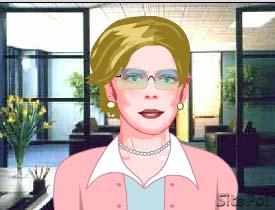
A little spendy but very interesting technology.
Here's the character I created.
I dressed her conservatively (more like me) but there are a number of clothing options including uniforms for all the main branches of the military, civilian uniformed occupations, sports, etc. I found a pair of glasses similar to mine and colored her hair (there wasn't a graying option though). I aged her some to get the lines in the neck, widened her face and her shoulders , changed the color of her eyes and added eye makeup. I notice there is a facial features option but it is not available in the demo. Hat choices is also grayed out. The background choices are a bit on the boring side but you can upload your own.
I see their gold package includes an AI engine for answering questions. I tried out the Text-to-Speech feature (available in the Silver and Gold editions) and it is very natural sounding. All the controls are very intuitive and the result is quite impressive. I see you can even hire "professional" voice talent for only $50 per minute!
http://www.oddcast.com/sitepal2/?&affId=16968
Monday, May 09, 2005
Internet Phones Arrive at Home (and Some Need No Computer)
 The New York Times: "A few years ago, a buzz began spreading about Internet telephony, a technology allowing telephone conversations to be made across the Internet rather than exclusively over regular phone lines.
More recently, Internet phone technology - also known as voice over Internet protocol, or VoIP - made inroads into businesses using heavy-duty equipment from companies like Cisco.
Now, thanks to providers like Vonage and others, it has found its way into the home. The service is sometimes choppy, but costs are low and quality is satisfactory for routine calls. Moreover, Internet protocol lends itself to inexpensive videoconferencing as well, useful for informal video chats between friends or business associates.
An example of a videoconferencing option that requires no computer is the Broadband Video Phone from Packet8 (www.8x8.com). At $99, this may be the best overall choice for VoIP enthusiasts; it offers fully functional video and audio calling at low cost.
The device looks much like an office phone but has a pop-up screen and can also be hooked up to a television. Its video quality is good but not great - flawless at times, but capable of quickly degrading, especially if either party moves quickly.
As a phone, though, it sparkles. It is hard to tell it is not a regular land line, and that factor separates the device from its peers. Also attractive is its ease of setup: plug in an Ethernet cable and you're all set. Service for the device runs $19.95 a month for unlimited video calls and unlimited voice calls in the United States and Canada."
I'm very pleased to see this technology finally coming into its own. I tried VOIP a number of years ago in its infancy and it turned out quite helpful to a friend who lost his father and was able to call back and forth to the Midwest several times a day to help his mother with funeral arrangements and afterward as she adjusted to living alone.
Wednesday, April 20, 2005
Using Shutter Speed Priority Setting with Panasonic FZ20 the answer to nonflash interior photography
In my second major outing with the Panasonic FZ20 digital camera I obtained much better results indoors where flash was prohibited and low lighting was a significant issue. I was attending the Historical Novel Society conference in Salt Lake City and visited the University of Utah Museum of Fine Art. I set the ISO sensitivity to 400 and used the Shutter Speed priority setting with a speed of 1/30 second. I was then able to get adequately-exposed sharp images thanks to the built-in digital stabilization system in the camera. Although there is increased noise in the images because of the high sensitivity setting, the pictures were still quite acceptable.
I wish I had used this setting more often in Rome. Most museums, both here and in Italy, do not permit the use of tripods (or flash). Even the digital stabilization system cannot compensate enough if the Automatic Program setting drops the shutter speed to less than 1/30 second. Without a tripod this makes it almost impossible, especially with a person like me with familial tremor, to get a sharp image.
I hope to return to Italy in 2008 and reshoot some of the darker exhibits in the Capitoline, National, and Vatican Museums. I also hope to spend several days in Florence next time so I can get a reservation for the Uffitzi Gallery, get an opportunity to photograph the exhibits at the Museum of Roman Civilization in Fermi, and the displays in the Archaeological Museum of Naples.
In the meantime I plan to attend the King Tut exhibition in Los Angeles and visit the Getty Museum while I am there as well. I want to experiment a little with the stabilizer mode setting. According to the article I have link referenced the Mode 2 setting (not the default) will actually produce a sharper image:
"When the "mode 1" setting is used, the stabilizer is always running, which helps you compose your photo. Mode 2 only activates the stabilizer when the picture is actually taken, which actually does a better job of eliminating camera shake."
I also want to experiment with the White Balance adjustment. I had problems in Rome using the present Program setting when shooting flash pictures of bronze figures. It resulted in them looking like a negative. Perhaps adjusting the white balance would resolve this problem.
I wish I had used this setting more often in Rome. Most museums, both here and in Italy, do not permit the use of tripods (or flash). Even the digital stabilization system cannot compensate enough if the Automatic Program setting drops the shutter speed to less than 1/30 second. Without a tripod this makes it almost impossible, especially with a person like me with familial tremor, to get a sharp image.
I hope to return to Italy in 2008 and reshoot some of the darker exhibits in the Capitoline, National, and Vatican Museums. I also hope to spend several days in Florence next time so I can get a reservation for the Uffitzi Gallery, get an opportunity to photograph the exhibits at the Museum of Roman Civilization in Fermi, and the displays in the Archaeological Museum of Naples.
In the meantime I plan to attend the King Tut exhibition in Los Angeles and visit the Getty Museum while I am there as well. I want to experiment a little with the stabilizer mode setting. According to the article I have link referenced the Mode 2 setting (not the default) will actually produce a sharper image:
"When the "mode 1" setting is used, the stabilizer is always running, which helps you compose your photo. Mode 2 only activates the stabilizer when the picture is actually taken, which actually does a better job of eliminating camera shake."
I also want to experiment with the White Balance adjustment. I had problems in Rome using the present Program setting when shooting flash pictures of bronze figures. It resulted in them looking like a negative. Perhaps adjusting the white balance would resolve this problem.
Blogger upgrade troublesome
Ever since Blogger upgraded one of its central kernels a couple of weeks ago I have had repeated problems with publishing from the edit posts and compose posts screens. I've reported it twice but the problem seems to continue. It is getting really irritating. I tried to post something last week and it would just keep flashing 0% on the publishing progress screen and never seem to complete the publishing process. However, now that I have returned from a conference and checked the blog, it seemed to have actually published it somehow. Whether it did it without updating the progress screen or tech support forced it after receiving my trouble report I don't know but I hope they get all the kinks worked out soon. It's really annoying.
Friday, March 04, 2005
Flickr Appears to Be Target of Buyout Efforts
I noticed there was a discussion thread on the Flickr bulletin board that was speculating on the impact of a potential buyout from either Yahoo or Google. I love Flickr's ease of use and have over 2000 images posted to my professional Flickr account so of course any rumors about a buyout are a bit unnerving.
However, I must admit that Google's buyout of Blogger turned out to be quite positive. With Google's financial muscle, Blogger was able to go to a full featured totally free product and I have had no regrets about that merger. I don't know what Yahoo would have in mind. I think I would prefer a Google takeover, though, since I understand that Google collaborated on the search mechanism Flickr incorporated into the service and it would be a wonderful enhancement to Google's existing image search service.
However, I must admit that Google's buyout of Blogger turned out to be quite positive. With Google's financial muscle, Blogger was able to go to a full featured totally free product and I have had no regrets about that merger. I don't know what Yahoo would have in mind. I think I would prefer a Google takeover, though, since I understand that Google collaborated on the search mechanism Flickr incorporated into the service and it would be a wonderful enhancement to Google's existing image search service.
Television Media and Computers offer Children Pluses and Minuses
Some interesting research from the National Science Foundation:
US NSF News"A consortium of researchers has reported that very young children’s interactions with TV and computers are a mixed bag of opportunities and cautions, while teenagers’ Internet use has changed so much that the myths of several years ago need to be debunked.
Said Amy Sussman, program manager for the National Science Foundation (NSF), which funds the five-site Children’s Digital Media Center (CDMC), "Reaping the benefits of various media while avoiding pitfalls is no easy task. Parents and policymakers need to inform their decisions about whether and how to guide their children’s media use through scientific knowledge. Different developmental stages call for different strategies. These and other research studies can help create needed guidance for children at all ages."
"Several individual studies support the 1999 recommendation by the American Academy of Pediatrics that parents do not expose children to electronic screens until they are 2 years old.
One important distinction is between “background TV” and “foreground TV” – that is, TV programs that are playing when young children are around (for example, because the TV is always on in the house) or TV programs designed for young children (for example, Teletubbies). Over a third of the households with children from birth to 6 years old had the TV on most or all of the time, in a study reported by Vandewater and colleagues. Children in these "heavy-television households" watched TV more and read less than other children. In addition, research summarized by Daniel R. Anderson and Tiffany A. Pempek indicates very little evidence that children younger than 2 years old learn much from even so-called "educational" programs and videos, and, furthermore, that background TV may be associated with poorer cognitive outcomes."
What happens when children become teenagers?
"Research findings reveal that teens’ Internet use focuses on identity, sexuality, social attitudes, and values – issues perennially associated with the teenage years. Online dangers include pervasive pornography and other sexually explicit material, disembodied strangers who may pursue others or express hate and racism, and rampant commercialism. However, teenagers also find information they may be hesitant to seek elsewhere, good communication channels with their friends, and advice and support."
US NSF News"A consortium of researchers has reported that very young children’s interactions with TV and computers are a mixed bag of opportunities and cautions, while teenagers’ Internet use has changed so much that the myths of several years ago need to be debunked.
Said Amy Sussman, program manager for the National Science Foundation (NSF), which funds the five-site Children’s Digital Media Center (CDMC), "Reaping the benefits of various media while avoiding pitfalls is no easy task. Parents and policymakers need to inform their decisions about whether and how to guide their children’s media use through scientific knowledge. Different developmental stages call for different strategies. These and other research studies can help create needed guidance for children at all ages."
"Several individual studies support the 1999 recommendation by the American Academy of Pediatrics that parents do not expose children to electronic screens until they are 2 years old.
One important distinction is between “background TV” and “foreground TV” – that is, TV programs that are playing when young children are around (for example, because the TV is always on in the house) or TV programs designed for young children (for example, Teletubbies). Over a third of the households with children from birth to 6 years old had the TV on most or all of the time, in a study reported by Vandewater and colleagues. Children in these "heavy-television households" watched TV more and read less than other children. In addition, research summarized by Daniel R. Anderson and Tiffany A. Pempek indicates very little evidence that children younger than 2 years old learn much from even so-called "educational" programs and videos, and, furthermore, that background TV may be associated with poorer cognitive outcomes."
What happens when children become teenagers?
"Research findings reveal that teens’ Internet use focuses on identity, sexuality, social attitudes, and values – issues perennially associated with the teenage years. Online dangers include pervasive pornography and other sexually explicit material, disembodied strangers who may pursue others or express hate and racism, and rampant commercialism. However, teenagers also find information they may be hesitant to seek elsewhere, good communication channels with their friends, and advice and support."
Friday, February 25, 2005
Visions of Profit in Podcasting
I have been a big fan of Audible.com since becoming one of it's first customers several years ago. So, I was quite interested in reading about the company's plans to leverage podcasts with its download distribution system. Although I have never ordered any of Audible's periodical subscriptions, I have always thought it would be a great customer service if some of the magazines I subscribe to would offer an audio version that I could listen to on my commute since my attention is less divided then than at home where I am usually bustling about cleaning up the kitchen, taking care of my two puppies, tending my husband, trying to read the paper and catching the occasional remark on television.
The New York Times : "Last week, Audible.com, which in 1994 pioneered the idea of using the Internet to download audio books and other audio material to personal computers, said that it would soon join the podcasting movement. The company, whose business currently includes distributing popular radio programs like 'Car Talk' on a subscription basis over the Internet, now says it intends to make its software and distribution system available to people who want to produce their own podcasts.
'When I started Audible and we started signing up radio partners, people would ask me, 'where does your technology leave radio?,' ' said Donald Katz, Audible's chairman. 'Now it's clear that the creative capacity that is out there greatly outstrips the capacity of the radio pipeline.'"
The New York Times : "Last week, Audible.com, which in 1994 pioneered the idea of using the Internet to download audio books and other audio material to personal computers, said that it would soon join the podcasting movement. The company, whose business currently includes distributing popular radio programs like 'Car Talk' on a subscription basis over the Internet, now says it intends to make its software and distribution system available to people who want to produce their own podcasts.
'When I started Audible and we started signing up radio partners, people would ask me, 'where does your technology leave radio?,' ' said Donald Katz, Audible's chairman. 'Now it's clear that the creative capacity that is out there greatly outstrips the capacity of the radio pipeline.'"
Thursday, February 24, 2005
Sad, Lonely? For a Good Time, Call Vivienne*
 The New York Times > Technology > Sad, Lonely? For a Good Time, Call Vivienne*: I see that Artificial Life, the company that produced the software I used to create virtual Caesar, has apparently abandoned their efforts to sell ridiculously priced virtual sales agents and have turned to development of "virtual" friends for lonely cell phone users.
One of the biggest problems they encountered in their original product line, in my opinion, was the amount of time and knowledge it takes to produce a custom virtual agent for a particular company with a specific focus. Now, they are concentrating on producing non-specific "friends" that can be programmed with generic "chit-chat" and used by a much larger pool of potential customers. I suppose this might be a more viable business model but sadly, like the shallow entertainment of "reality" television, it does little to explore the educational potential of their software.
"Eberhard Schoneburg, the chief executive of the software maker Artificial Life Inc. of Hong Kong, may have found the answer: a virtual girlfriend named Vivienne who goes wherever you go.
Vivienne likes to be taken to movies and bars. She loves to be given virtual flowers and chocolates, and she can translate six languages if you travel overseas. She never undresses, although she has some skimpy outfits for the gym, and is a tease who draws the line at anything beyond blowing kisses.
If you marry her in a virtual ceremony, you even end up with a virtual mother-in-law who really does call you in the middle of the night on your cellphone to ask where you are and whether you have been treating her daughter right.
She may sound like a mixed blessing, decidedly high maintenance and perhaps the last resort of losers. But she is nonetheless a concept that cellphone system operators and handset manufacturers are starting to embrace.
Vivienne, the product of computerized voice synthesis, streaming video and text messages, is meant not only to bring business to Artificial Life (she will be available for a monthly fee of $6, not including the airtime costs paid to cellphone operators or the price of virtual chocolates and flowers). But she is also meant to be a lure for the new, higher-tech, third generation, or 3G, cellphones."
Tuesday, February 22, 2005
Panasonic FZ20 offers challenging options to the digital photographer
In preparation for my upcoming trip to Italy, I have been studying up on the features of our new Panasonic FZ20 Luminix digital camera. I've taken a few shots with it but it seemed to require quite a bit more "fiddling" than my reliable Sony Mavica FD-81. Today, however, I think I identified some of the default settings that may have been causing me some trouble. I noticed that the Auto Focus Continuous setting was not set to on. This meant that there was a slight delay once I pressed the shutter before the camera began it's auto focus routine and may have resulted in some of my earlier images being a little fuzzy. I'm used to the Mavica being focussed almost instantly. I'm hoping that my setting this feature to on will help. I also noticed that the Auto Focus feature was set to only a single point even though the camera is capable of using a nine point focus system. In some of my earlier images, I noticed that the focus seemed less sharp as the image radiated out from the center. I thought it was a result of a shallow depth of field but this may not be the problem after all. I set this feature to the maximum of 9 point focus so we'll see how this affects the overall sharpness of the picture.
I also set the programmable Scene 1 setting to "Party" a setting for obtaining sharp focus in a low light condition. I set the programmable Scene 2 setting to "Scenery" for instant maximum depth of field and sharp focus. These are the majority of types of shots I think I will need.
I have also called our Museum of Art and requested permission to come over and photograph some of their ancient art objects in their exhibition setting so I can determine the best settings for focus and true color reproduction.
I also set the programmable Scene 1 setting to "Party" a setting for obtaining sharp focus in a low light condition. I set the programmable Scene 2 setting to "Scenery" for instant maximum depth of field and sharp focus. These are the majority of types of shots I think I will need.
I have also called our Museum of Art and requested permission to come over and photograph some of their ancient art objects in their exhibition setting so I can determine the best settings for focus and true color reproduction.
Thursday, February 10, 2005
Resurrecting a weblog
This weblog was began in September of 2003 using an open source weblog tool called Blosxom that was written in Perl. I really liked the modularity of blosxom and some of the plugins designed for it, especially utilities like the magic link plugin that would recognize a word from your links list and automatically link it to a URL specified in your link list file (Example: Apple would automatically link to http://www.apple.com). However, it became clear over the course of a year that the basic program lacked critical security features that prevented unfortunate events like spammers flooding a blog with advertising through the comments function and code that would prevent the output of an invalid RSS feed or cause internal server errors simply from the use of an international character or reference to a particularly long URL. Therefore, I decided to end my experiment with the tool.
However, I know there are a number of people interested in further development of Blosxom and I wanted to preserve my experiences with the program in the hope that they would prove useful to someone else. Therefore, I transferred all of my posts to this new Blogger blog and, using Blogger's date change utilities, modified the dates of my earlier posts to match the time frame they were actually posted.
I will now go forward with this blog posting my experiences with other technology tools and thoughts about tools in development. Hopefully, other technology enthusiasts will find them helpful as well.
However, I know there are a number of people interested in further development of Blosxom and I wanted to preserve my experiences with the program in the hope that they would prove useful to someone else. Therefore, I transferred all of my posts to this new Blogger blog and, using Blogger's date change utilities, modified the dates of my earlier posts to match the time frame they were actually posted.
I will now go forward with this blog posting my experiences with other technology tools and thoughts about tools in development. Hopefully, other technology enthusiasts will find them helpful as well.
Tuesday, July 27, 2004
Olivier makes comeback from beyond the grave
Another step towards virtual actors:
"Laurence Olivier is to make his Hollywood comeback alongside Jude Law and Gwyneth Paltrow in the sci-fi blockbuster Sky Captain and the World of Tomorrow. It will be the Oscar-winning actor's first screen role following an enforced 15-year lay-off. The lay-off began, understandably enough, with his death in 1989.
Thanks to the wonders of digital technology, Olivier will now be resurrected to "play" the role of a villainous overlord who commands an army of giant killer robots. The film will splice together old movie scenes and archive footage of the actor in his youth, although Olivier's classic clipped delivery will be voiced by another actor. Explaining the decision at the annual Comic-Con sci-fi convention in San Diego, Jude Law said that no living actor possesses the same gravitas and authority."
"Laurence Olivier is to make his Hollywood comeback alongside Jude Law and Gwyneth Paltrow in the sci-fi blockbuster Sky Captain and the World of Tomorrow. It will be the Oscar-winning actor's first screen role following an enforced 15-year lay-off. The lay-off began, understandably enough, with his death in 1989.
Thanks to the wonders of digital technology, Olivier will now be resurrected to "play" the role of a villainous overlord who commands an army of giant killer robots. The film will splice together old movie scenes and archive footage of the actor in his youth, although Olivier's classic clipped delivery will be voiced by another actor. Explaining the decision at the annual Comic-Con sci-fi convention in San Diego, Jude Law said that no living actor possesses the same gravitas and authority."
Thursday, July 22, 2004
Researchers attempt to develop software to authenticate digital photos
As a digital photographer myself, I was particularly interested in the methods being developed by researchers to authenticate digital images.
"It used to be that you had a photograph, and that was the end of it - that was truth," said Hany Farid, an associate professor of computer science at Dartmouth College who is a leader in the field. "We're trying to bring some of that back. To put some measure of guarantee back in photography."
Over the last three years, Professor Farid and his students have become experts at forgery, making hundreds of images that look authentic but have in fact been digitally tweaked. License plate numbers are changed. A single stool standing on a checkerboard floor is suddenly a pair of stools. Dents on a car are wiped away with a few mouse clicks.
The skillful tampering disturbed the images in ways that the human eye could not detect. But Professor Farid says his algorithms can spot them and sound the alarm.
Jessica Fridrich, a research professor in electrical and computer engineering at the State University of New York at Binghamton, is approaching the fraud problem from the other side. She is trying to figure out who took the digital picture in the first place.
Just like the rifling in a gun barrel leaves a distinctive pattern on the bullets it fires, a digital camera has a signature of sorts. Today's digital cameras have sensors with millions of pixels. In each camera, a small handful of these are either too bright or are burnt out entirely. When a camera takes a picture, the imperfections leave a unique pattern, Professor Fridrich has discovered in preliminary research.
Now, she is trying to embed a bit of the photographer in the picture, too. The patterns in the iris - the colored part of the eye - are at least as distinctive as a person's fingerprint. With money from the Air Force, Professor Fridrich is designing a camera that takes two pictures at once: one though the camera lens, and a smaller one of the photographe's iris. The iris image along with the time and place of the photo session would then be compressed, encrypted and instantly hidden within the larger picture just taken.
"It used to be that you had a photograph, and that was the end of it - that was truth," said Hany Farid, an associate professor of computer science at Dartmouth College who is a leader in the field. "We're trying to bring some of that back. To put some measure of guarantee back in photography."
Over the last three years, Professor Farid and his students have become experts at forgery, making hundreds of images that look authentic but have in fact been digitally tweaked. License plate numbers are changed. A single stool standing on a checkerboard floor is suddenly a pair of stools. Dents on a car are wiped away with a few mouse clicks.
The skillful tampering disturbed the images in ways that the human eye could not detect. But Professor Farid says his algorithms can spot them and sound the alarm.
Jessica Fridrich, a research professor in electrical and computer engineering at the State University of New York at Binghamton, is approaching the fraud problem from the other side. She is trying to figure out who took the digital picture in the first place.
Just like the rifling in a gun barrel leaves a distinctive pattern on the bullets it fires, a digital camera has a signature of sorts. Today's digital cameras have sensors with millions of pixels. In each camera, a small handful of these are either too bright or are burnt out entirely. When a camera takes a picture, the imperfections leave a unique pattern, Professor Fridrich has discovered in preliminary research.
Now, she is trying to embed a bit of the photographer in the picture, too. The patterns in the iris - the colored part of the eye - are at least as distinctive as a person's fingerprint. With money from the Air Force, Professor Fridrich is designing a camera that takes two pictures at once: one though the camera lens, and a smaller one of the photographe's iris. The iris image along with the time and place of the photo session would then be compressed, encrypted and instantly hidden within the larger picture just taken.
Thursday, January 29, 2004
The Tyranny of Copyright
''The notion that intellectual property rights should never expire, and works never enter the public domain -- this is the truly fanatical and unconstitutional position,'' says Jonathan Zittrain, a co-founder of the Berkman Center for Internet and Society at Harvard Law School, the intellectual hub of the Copy Left.
Thinkers like Lessig and Zittrain promote a vision of a world in which copyright law gives individual creators the exclusive right to profit from their intellectual property for a brief, limited period -- thus providing an incentive to create while still allowing successive generations of creators to draw freely on earlier ideas. They stress that borrowing and collaboration are essential components of all creation and caution against being seduced by the romantic myth of ''the author'': the lone garret-dwelling poet, creating masterpieces out of thin air. ''No one writes from nothing,'' says Yochai Benkler, a professor at Yale Law School. ''We all take the world as it is and use it, remix it.''
Thinkers like Lessig and Zittrain promote a vision of a world in which copyright law gives individual creators the exclusive right to profit from their intellectual property for a brief, limited period -- thus providing an incentive to create while still allowing successive generations of creators to draw freely on earlier ideas. They stress that borrowing and collaboration are essential components of all creation and caution against being seduced by the romantic myth of ''the author'': the lone garret-dwelling poet, creating masterpieces out of thin air. ''No one writes from nothing,'' says Yochai Benkler, a professor at Yale Law School. ''We all take the world as it is and use it, remix it.''
Monday, December 08, 2003
Game Companies Embrace Mod Builders
Since my son has described his efforts at modifying some of his favorite games, I was particularly interested in this article about game companies recognizing the market potential of "mod" builders.
"In recent years, players dedicated to modifying store-bought computer games have morphed into an underground movement - mod makers, as they often call themselves. Now they are showing signs of breaking into the mainstream as game developers are increasingly willing to give away the very software tools they use to construct the games, including them on the disc with the game itself."
"As a result, working alone or in teams, the mod makers are spending hundreds of hours tweaking or completely redrawing popular games to be played on their own terms. The payoff is fun and bragging rights, and just maybe a career in the multibillion-dollar electronic game industry."
"In recent years, players dedicated to modifying store-bought computer games have morphed into an underground movement - mod makers, as they often call themselves. Now they are showing signs of breaking into the mainstream as game developers are increasingly willing to give away the very software tools they use to construct the games, including them on the disc with the game itself."
"As a result, working alone or in teams, the mod makers are spending hundreds of hours tweaking or completely redrawing popular games to be played on their own terms. The payoff is fun and bragging rights, and just maybe a career in the multibillion-dollar electronic game industry."
Friday, November 14, 2003
Penn State Formerly Announces Music Subscription Service
em>I see Penn State has formally announced the music subscription service that President Spanier mentioned in his Educause panel discussion on peer-to-peer file sharing and antipiracy efforts.
"Pennsylvania State University has agreed to cover the cost of providing its students with a legal method to download music from a catalog of half a million songs, in a departure from punitive efforts to curtail music swapping on college campuses."
"The deal between Penn State and the newly revised Napster online service is expected to serve as a model for other universities. It comes as the music industry applies pressure on students and colleges in its antipiracy campaign."
"The service will allow students to listen to an unlimited number of songs as often as they want. They will be able to download the music to use on three personal computers as long as students are at Penn State. If they want to keep the songs permanently or burn them to a CD, though, they will have to pay 99 cents each."
"Dr. Spanier said the university will pay for the Napster service out of the $160 information technology fee students pay each year. The cost to the university is "substantially less" than the $9.95 fee that individual subscribers pay for the Napster service, he said, though he declined to disclose the precise terms."
"Pennsylvania State University has agreed to cover the cost of providing its students with a legal method to download music from a catalog of half a million songs, in a departure from punitive efforts to curtail music swapping on college campuses."
"The deal between Penn State and the newly revised Napster online service is expected to serve as a model for other universities. It comes as the music industry applies pressure on students and colleges in its antipiracy campaign."
"The service will allow students to listen to an unlimited number of songs as often as they want. They will be able to download the music to use on three personal computers as long as students are at Penn State. If they want to keep the songs permanently or burn them to a CD, though, they will have to pay 99 cents each."
"Dr. Spanier said the university will pay for the Napster service out of the $160 information technology fee students pay each year. The cost to the university is "substantially less" than the $9.95 fee that individual subscribers pay for the Napster service, he said, though he declined to disclose the precise terms."
Thursday, November 13, 2003
EyeToy Utilizes Playstation2 USB video capabilities
"RICHARD MARKS, a 34-year-old astronautical and aeronautical engineer, has been spending a lot of time lately pretending to be Harry Potter. His wand is made from parts of a hotel clothes hanger and has a brightly colored ball on one end. But when he waves it, Dr. Marks says, it begins to glow and emit a distinctive hum in a TV monitor across the room."
"By moving the wand in a circle, he can produce a trail that turns into a ring of fire on the screen. By flicking the wand toward the TV, he can make a fireball sizzle across the monitor. Other geometric shapes conjure tornadoes or make the player invisible. "I actually had my son draw up a list of spells he thought would be good," Dr. Marks said."
"Don't put in an emergency call to the Ministry of Magic just yet. Dr. Marks, a special-projects manager for research and development at Sony Computer Entertainment America, is only recounting his exploits with EyeToy, a miniature camera he invented that attaches to the PlayStation 2 and translates body movements into a video game."
I noticed ads for this little device in our local technology store newspaper inserts. Until I read this article, however, I couldn't quite understand all of its potential.
"By moving the wand in a circle, he can produce a trail that turns into a ring of fire on the screen. By flicking the wand toward the TV, he can make a fireball sizzle across the monitor. Other geometric shapes conjure tornadoes or make the player invisible. "I actually had my son draw up a list of spells he thought would be good," Dr. Marks said."
"Don't put in an emergency call to the Ministry of Magic just yet. Dr. Marks, a special-projects manager for research and development at Sony Computer Entertainment America, is only recounting his exploits with EyeToy, a miniature camera he invented that attaches to the PlayStation 2 and translates body movements into a video game."
I noticed ads for this little device in our local technology store newspaper inserts. Until I read this article, however, I couldn't quite understand all of its potential.
Monday, November 10, 2003
Disneyland lacks interactivity
Yesterday, I revisited Disneyland after 37 years. Not surprisingly, it seemed rather dated to me although the children under about 10 seemed to be enjoying themselves. I think the problem with many of the offerings that were not just outright motion rides that always appear to appeal to younger age groups, was that they are just too passive now that we are growing increasingly accustomed to an interactive environment. I was particularly disappointed in the "new" Indiana Jones ride. As you lurched along in a track-controlled vehicle, little scenes would appear along with way with an animatronic Indiana Jones warning you about your precarious position. I think a telling indicator about the lack of impact of the experience was the absence of anyone saying "let's do that again" as I walked through the exit tunnel.
Now, what I think would have been a superior experience would have been a walking/running journey in which each participant is given a bullwhip, a sack of sand, and a fedora and you are told you have ten minutes to complete your mission. As you proceed cautiously through the cave, creatures, activated by a disturbed laser beam, scurry across in front of you and Disney would use the same air puff technololgy as they use in "Honey, I Shrunk The Audience" to make it feel like they are scurring across your feet and ankles, You are confronted by what appears to be a bottomless pit with a vine hanging over it that you must grasp and swing across, As you round a corner and see a fork in the trail, a laser beam activated rack with a simulated body pierced by stakes swings down in front of you blocking your path down one fork of the trail. You enter a chamber where snakes appear to block your path. You must snap them with the bullwhip to get them out of your way. You make it to the map room where you must pick up the crystal-embedded staff and try to position it into the map so a beam of light will activate to provide a clue to a successful mission. You finally arrive in the cave with the golden statue on the weight-sensitive altar and you must try to judge how much sand to leave in the pouch and carefully remove the statue and replace it simulataneously with the sand pouch. Temple walls appear to start to fall and you turn and run for the exit. Laser activated darts fly across in front of you as you dash down the corridor which has been reconfigured with a movable partition to shunt you off into a different tunnel. As you run you see a big boulder rolling towards you and you look desperately for the simulated cobweb-occluded escape slide that deposits you amid tropical plants and native warriors pointing a spear at you. The warriors separate and the Last Templar steps forward offering you a selection of cups on a tray in exchange for the statue (if you still have it). He tells you to "Choose but choose wisely". At the bottom of one of the cups is the offer of a free copy of a picture of you somewhere during your experience. Movable partitions could be used to create a variety of pathways to increase the replayability of the attraction.
I revisited Pirates of the Carribean and the Jungle Cruise. I've done "Star Tours" in Orlando so I didn't bother to take the opportunity to hurt my back any more than it already is. I think of the "ride" experiences, I enjoyed the Davy Crockett canoes the best. It was a beautiful day and it was relaxing just to paddle around the waterway. I smiled to myself as I watched a little boy of about three (the same age as one of my grandsons) swish his paddle through the water with such a serious face. I'm sure he was convinced he was doing his part as a real frontiersman.
I also particularly enjoyed the Abe Lincoln presentation. The dimensional sound experience was nicely done and I thought it was interesting to hear the sounds of the Civil War and its participants from the viewpoint of a soldier.
One of the most disappointing "reunions" was my tour through the Haunted Mansion. It had been redecorated with cartoon images from Tim Burrton's "A Nightmare Before Christmas". I didn't think the film was worth seeing when it was released and it definitely detracted from the Haunted Mansion experience.
The Parade of Stars at the end of the day was enjoyable. I got quite a kick out of some of the park guests who had been commandeered to participate in the parade. There were big husky guys dressed in tootoos trying their best to piroette when instructed to do so by the Disney "choreographer". Of course the Disney heroines were beautiful (Snow White, Cinderella, Ariel, etc.) and Tarzan was quite a hunk! Later I saw a little girl whose parents had bought her what I thought was a Cinderella costume (actually it was an Ariel costume I learned later) and she was just walking along waving gracefully to the other visitors that passed by as if she was Cinderella herself.
Thursday night, Educause sponsors treated everyone to a Party In The Park over at Disney's California Great Adventure park. Although I enjoyed the "Soaring Over California" Omnimax-type experience, the rest of the park was little more than a 50s-type carnival with the old manual games of throwing balls and typical rollercoaster, Octopus, and ferris wheel-type rides. I'm glad it was provided at no charge because I definitely would not have paid $47 to spend the day there. In fact, the few hours we were there was more than ample for me.
Now, what I think would have been a superior experience would have been a walking/running journey in which each participant is given a bullwhip, a sack of sand, and a fedora and you are told you have ten minutes to complete your mission. As you proceed cautiously through the cave, creatures, activated by a disturbed laser beam, scurry across in front of you and Disney would use the same air puff technololgy as they use in "Honey, I Shrunk The Audience" to make it feel like they are scurring across your feet and ankles, You are confronted by what appears to be a bottomless pit with a vine hanging over it that you must grasp and swing across, As you round a corner and see a fork in the trail, a laser beam activated rack with a simulated body pierced by stakes swings down in front of you blocking your path down one fork of the trail. You enter a chamber where snakes appear to block your path. You must snap them with the bullwhip to get them out of your way. You make it to the map room where you must pick up the crystal-embedded staff and try to position it into the map so a beam of light will activate to provide a clue to a successful mission. You finally arrive in the cave with the golden statue on the weight-sensitive altar and you must try to judge how much sand to leave in the pouch and carefully remove the statue and replace it simulataneously with the sand pouch. Temple walls appear to start to fall and you turn and run for the exit. Laser activated darts fly across in front of you as you dash down the corridor which has been reconfigured with a movable partition to shunt you off into a different tunnel. As you run you see a big boulder rolling towards you and you look desperately for the simulated cobweb-occluded escape slide that deposits you amid tropical plants and native warriors pointing a spear at you. The warriors separate and the Last Templar steps forward offering you a selection of cups on a tray in exchange for the statue (if you still have it). He tells you to "Choose but choose wisely". At the bottom of one of the cups is the offer of a free copy of a picture of you somewhere during your experience. Movable partitions could be used to create a variety of pathways to increase the replayability of the attraction.
I revisited Pirates of the Carribean and the Jungle Cruise. I've done "Star Tours" in Orlando so I didn't bother to take the opportunity to hurt my back any more than it already is. I think of the "ride" experiences, I enjoyed the Davy Crockett canoes the best. It was a beautiful day and it was relaxing just to paddle around the waterway. I smiled to myself as I watched a little boy of about three (the same age as one of my grandsons) swish his paddle through the water with such a serious face. I'm sure he was convinced he was doing his part as a real frontiersman.
I also particularly enjoyed the Abe Lincoln presentation. The dimensional sound experience was nicely done and I thought it was interesting to hear the sounds of the Civil War and its participants from the viewpoint of a soldier.
One of the most disappointing "reunions" was my tour through the Haunted Mansion. It had been redecorated with cartoon images from Tim Burrton's "A Nightmare Before Christmas". I didn't think the film was worth seeing when it was released and it definitely detracted from the Haunted Mansion experience.
The Parade of Stars at the end of the day was enjoyable. I got quite a kick out of some of the park guests who had been commandeered to participate in the parade. There were big husky guys dressed in tootoos trying their best to piroette when instructed to do so by the Disney "choreographer". Of course the Disney heroines were beautiful (Snow White, Cinderella, Ariel, etc.) and Tarzan was quite a hunk! Later I saw a little girl whose parents had bought her what I thought was a Cinderella costume (actually it was an Ariel costume I learned later) and she was just walking along waving gracefully to the other visitors that passed by as if she was Cinderella herself.
Thursday night, Educause sponsors treated everyone to a Party In The Park over at Disney's California Great Adventure park. Although I enjoyed the "Soaring Over California" Omnimax-type experience, the rest of the park was little more than a 50s-type carnival with the old manual games of throwing balls and typical rollercoaster, Octopus, and ferris wheel-type rides. I'm glad it was provided at no charge because I definitely would not have paid $47 to spend the day there. In fact, the few hours we were there was more than ample for me.
Interactive Powerpoint the basis for new classroom interactivity
Interactive response tools appear to be coming on strong. I saw two products designed around Interactive Powerpoint. Although both offered keypad devices, they also had virtual keypad clients for handheld devices. They had similar functionality but one stored response data in Excel while the other used an SQL database for a foundation. Also, the Excel-based model used a device client while the SQL product was browser-based. My primary concern with both products was the residence of the resulting data on the instructor laptop. I would have much preferred a client/server environment for the instructor as laptop loaners are particularly vulnerable to damage and theft.
Both products were in the $5,000 per instructor workstation with 50 student clients price range. Since Silicon Chalk offered response tracking as part of an integrated environment with a host of other features for only a $3 - $8 per seat price, I think I would prefer to explore it in preference to these products although I received a working demo of the Excel product that I can evaluate more fully.
Both products were in the $5,000 per instructor workstation with 50 student clients price range. Since Silicon Chalk offered response tracking as part of an integrated environment with a host of other features for only a $3 - $8 per seat price, I think I would prefer to explore it in preference to these products although I received a working demo of the Excel product that I can evaluate more fully.
Friday, November 07, 2003
Silicon Chalk Provides Powerful Feature Set with a Great Price
Another powerful tool with a lot of potential that I encountered is a new product from the original founder of WebCT called Silicon Chalk. (http://www.silicon-chalk.com). Silicon Chalk uses IP broadcast within a subnet (or multicast across subnets) to record and broadcast a class presentation between computers equipped with the Silicon Chalk Client. For example, an instructor presenting with Powerpoint and a microphone would have his/her screen presentation automatically recorded with voice over, timecoded and distributed to the workstations of each student. As the students listen to the lecture, they can type notes, send instant messages, and browse referenced websites. These activities of the student are also recorded and timecoded in synch with the instructor broadcast. The student's lecture file can then be used for review and even later notes can be added to particular portions of the lecture. This feature is especially important for students who missed the lecture.
The product can search sections of the presentation by text strings either within the instructor's powerpoint presentation or the students notes. The vendor explained that if, every time the instructor said something like "Now this is important. It will be included on the midterm", the student typed "midterm" in their note section. They could then easily retrieve any portion of the lecture in which "midterm" was mentioned. The product also includes a student polling function with the instructor having the control of display of the results. Best of all, this powerful product is very inexpensive. A pilot client is only $3 and even after the pilot period, the clients would cost in the neighborhood of only $8 based on the number of clients requested.
The product can search sections of the presentation by text strings either within the instructor's powerpoint presentation or the students notes. The vendor explained that if, every time the instructor said something like "Now this is important. It will be included on the midterm", the student typed "midterm" in their note section. They could then easily retrieve any portion of the lecture in which "midterm" was mentioned. The product also includes a student polling function with the instructor having the control of display of the results. Best of all, this powerful product is very inexpensive. A pilot client is only $3 and even after the pilot period, the clients would cost in the neighborhood of only $8 based on the number of clients requested.
Electronic Curriculum Vitae Product Promising
In the exhibit hall, I have discovered several products with the potential to address some of the problems we have experienced in the college. I reviewed an electronic curriculum vitae product developed by Academic Management Systems (http://www.academicmanagement.com) that had some nice features. It was similar in design to the online vitae program I initiated several years ago but they had taken the product several steps beyond capturing and categorizing vitae components. The product enabled faculty members to set up customized CV "views" to be used for different purposes and check or uncheck individual items so they could be excluded from a particular view if desired. It also used a date-based criterion so items could be included based on a particular time frame and had summary reporting capability displaying a breakdown of how much faculty effort was being expended in activity categories like instruction, research, outreach, etc. - extremely helpful for preparing such reports as the NCATE survey each year. It had a tiered access and security system based on organizational levels such as administration, department, user, and delegates.
They also had a product for online course assessment. I've been out of that loop for a while but I think CRIs are still being done with the old bubble sheets. It is essentially an online survey tool with a robust analysis and reporting module supported by a security system to filter views based on user status (student, instructor, administrator, etc.) I pointed out to the developer that the biggest challenge with online surveys is integrating the system with some student activity to ensure completion. I suggested to him that if the survey were treated like a final course assignment, completion of it could be managed by Blackboard if the product could send a completion confirmation to Blackboard. He said he was meeting with the Blackboard folks later in the day and would discuss my suggestion with them.
They also had a product for online course assessment. I've been out of that loop for a while but I think CRIs are still being done with the old bubble sheets. It is essentially an online survey tool with a robust analysis and reporting module supported by a security system to filter views based on user status (student, instructor, administrator, etc.) I pointed out to the developer that the biggest challenge with online surveys is integrating the system with some student activity to ensure completion. I suggested to him that if the survey were treated like a final course assignment, completion of it could be managed by Blackboard if the product could send a completion confirmation to Blackboard. He said he was meeting with the Blackboard folks later in the day and would discuss my suggestion with them.
Smart Music Interesting Product
I also attended a session on Ubiquitous Mobile Computing. I expected this presentation to be focussed on the new Wireless opportunities but instead it was a case study of a college that had installed a robust network then purchased laptop loaners for everyone on the campus including their students with the expectation that technology would be incorporated into every aspect of their educational experiences. They then presented examples of technology integration into a variety of disciplines. One of their students demonstrated a product called Smart Music that is used to provide accompaniment to vocal music students practicing for performance. When she first described the product, I thought to myself "What's the big deal - it's just karioke." But she explained how the product can be set to follow the singer instead of vice versa. She demonstrated this feature by singing a passage from the opera "Carmen". She sang several lines then paused in mid-stanza and the computer stopped at the same time. Then the computer displayed a "D" to let her know the next note. She sang several other notes but the music did not resume until she hit a properly pitched "D". Very impressive! I also appreciated her obvious enthusiasm for her learning experiences.
Educause's Virtual Communities of Practice
I attended a session on Virtual Communities of Practice but was a bit disappointed that the presenters appeared have little experience in actually maintaining a thriving online community. They mentioned a number of problems about the effort of facilitation and distribution of information that I think could be handled by a web log and RSS and even mentioned they were aware of blogs and RSS but when I questioned them further, they apparently had not even attempted to set up a group blog or encourage their members to blog about their professional experiences.
I suggested to them that they study the aspects of successful Yahoo groups but I could tell by their reaction that they considered that environment hardly worthy of academic consideration. Too bad. Our Imperial Rome discussion group has flourished, beginning with only a dozen members. It now has over 500 members and lively daily discussions that focus on topics quite in depth. I pointed out to the presenters that they need to try to leverage the gifts of their members. On our Imperial Rome discussion group, members that travel to historical sites upload their images, other members record their favorite ancient recipes, we have databases of Roman biographies, battles, and films, and I maintain an RSS-fed online news magazine about Roman archaeology, Academic presentations on the Roman Empire, and books, games, and multimedia with ancient themes. I also maintain a searchable database of images of the ancient world to be used for educational presentations.
I suggested to them that they study the aspects of successful Yahoo groups but I could tell by their reaction that they considered that environment hardly worthy of academic consideration. Too bad. Our Imperial Rome discussion group has flourished, beginning with only a dozen members. It now has over 500 members and lively daily discussions that focus on topics quite in depth. I pointed out to the presenters that they need to try to leverage the gifts of their members. On our Imperial Rome discussion group, members that travel to historical sites upload their images, other members record their favorite ancient recipes, we have databases of Roman biographies, battles, and films, and I maintain an RSS-fed online news magazine about Roman archaeology, Academic presentations on the Roman Empire, and books, games, and multimedia with ancient themes. I also maintain a searchable database of images of the ancient world to be used for educational presentations.
Peer-to-Peer discussion with Entertainment Execs Interesting
Yesterday's general session on the problem of peer-to-peer sharing of copyrighted materials was quite interesting. I especially enjoyed the "showmanship" of Jack Valenti. Even the attorney from the RIAA was articulate and came across as not at all threatening. I also found the president of Penn State quite intriguing.
Penn State is launching a project whereby the university has entered a partnership with RIAA to subscribe to an extensive database of music tracks to provide quality "legal" online music to their students as part of their university experience. Their motivation for this has apparently been threats from Congress under pressure from the powerful entertainment industry to pass legislation that would make the defacto ISP legally liable for the copyright violations of their constituent base. I thought it would only be a matter of time before this type of rumbling would surface because traditionally, claimants in court go after the target with the deepest pockets and a university would obviously have more financial base than the typical college student.
RIAA has apparently been pleased by the success of Apple's I-music initiative and applauds this effort as a viable business model that could be emulated by others. RIAA also appears to be taking a cue from the MPAA and is considering offering content-rich CDs or DVDs that would include value-added features like artist bios, music videos, etc. that would not typically be available from a pirate download site.
In presubmitted questions from the audience the issue was raised repeatedly of outdated business models and the industry being willing to eliminate middle men in their business that are essentially "dinosaurs" in the new online environment and reexamine pricing to be more reflective of the lower costs of this delivery mode. It reminds me a lot of the ebook market. Many publishers have been willing to jump on the ebook bandwagon but tried to price ebooks as high as a regular hardbound book even though the printing, inventory, and warehousing expenses had all been eliminated. That ridiculous pricing strategy coupled with a lack of a quality device to simulate the reading experience of a book with the features of digital manipulation has stifled the market thus far.
Penn State is launching a project whereby the university has entered a partnership with RIAA to subscribe to an extensive database of music tracks to provide quality "legal" online music to their students as part of their university experience. Their motivation for this has apparently been threats from Congress under pressure from the powerful entertainment industry to pass legislation that would make the defacto ISP legally liable for the copyright violations of their constituent base. I thought it would only be a matter of time before this type of rumbling would surface because traditionally, claimants in court go after the target with the deepest pockets and a university would obviously have more financial base than the typical college student.
RIAA has apparently been pleased by the success of Apple's I-music initiative and applauds this effort as a viable business model that could be emulated by others. RIAA also appears to be taking a cue from the MPAA and is considering offering content-rich CDs or DVDs that would include value-added features like artist bios, music videos, etc. that would not typically be available from a pirate download site.
In presubmitted questions from the audience the issue was raised repeatedly of outdated business models and the industry being willing to eliminate middle men in their business that are essentially "dinosaurs" in the new online environment and reexamine pricing to be more reflective of the lower costs of this delivery mode. It reminds me a lot of the ebook market. Many publishers have been willing to jump on the ebook bandwagon but tried to price ebooks as high as a regular hardbound book even though the printing, inventory, and warehousing expenses had all been eliminated. That ridiculous pricing strategy coupled with a lack of a quality device to simulate the reading experience of a book with the features of digital manipulation has stifled the market thus far.
Thursday, November 06, 2003
MIT Open Courseware, Copyright, Assessment topics discussed
The presentations are a little light duty on the technology side but I manage to pick up tidbits here and there. Yesterday I went to a session on MIT's open courseware initiative that was very interesting. I was particularly pleased to note that the MIT faculty were actually very supportive. They said they have received more attention for their work and their research from not only other universities around the world but even from their own colleagues in other disciplines. MIT arranges a license with the faculty members so they actually retain all copyrights with permission for MIT to provide the materials on the OCW site. The website clearly states the licensing provisions which prohibits the use of the materials for commercial purposes. Someone asked if MIT thought providing these materials would adversely impact enrollment but MIT's director said they don't think so but they are keeping an eye on it. I think it would boost their enrollment. Webstats on the OCW site shows that the site is generating over 9 million pageviews a month. That's nothing to sneeze at!
I went to a copyright session but the actual legalities were not explored in depth. I was surprised to learn that there are lawsuits in the courts that are trying to stop anti-spam and pop-up blocking products because they interfere with the content delivery intended by the content provider. (I hope the courts don't fall for that one)I guess there is also a lawsuit trying to gain a ruling on "deep linking" - linking directly to information on a website without forcing the viewer to navigate the site as intended by the conent provider. (that's another bummer) Apparently the internet's version of telemarketers are as persistent as those in the direct mail industry!
I attended a session on assessment strategies for online courses. The presenters definition of assessment was strategies to gain insight into the learning levels of the students. I think many of the attendees were expecting something else but I found the presenters rubric of dividing students into various levels of content and technology skill levels with the strategies to deal with each group interesting.
I went to a copyright session but the actual legalities were not explored in depth. I was surprised to learn that there are lawsuits in the courts that are trying to stop anti-spam and pop-up blocking products because they interfere with the content delivery intended by the content provider. (I hope the courts don't fall for that one)I guess there is also a lawsuit trying to gain a ruling on "deep linking" - linking directly to information on a website without forcing the viewer to navigate the site as intended by the conent provider. (that's another bummer) Apparently the internet's version of telemarketers are as persistent as those in the direct mail industry!
I attended a session on assessment strategies for online courses. The presenters definition of assessment was strategies to gain insight into the learning levels of the students. I think many of the attendees were expecting something else but I found the presenters rubric of dividing students into various levels of content and technology skill levels with the strategies to deal with each group interesting.
Wednesday, November 05, 2003
Integrated cell phones to dominate the handheld future?
Yesterday I attended the preconference seminar "Catch the Handheld Wave". The presenter focussed on introducing a typical handheld (Palm in her case) to education faculty as a first step in promoting the use of handhelds into the classroom. The College of Education at the University of Central Oklahoma obtained a grant from Palm and have developed a well accepted and well supported program for faculty using handheld devices. The integration program included formal training for both users and support personnel, an equipment loan program with accessories including camera, GPS, and scientific probes, and a stipend program to compensate faculty for producing learning modules for the devices. U of Central OK also requires teacher candidates to become proficient in the use of handheld devices and requires a handheld component in their graduation portfolio.
Classroom projects that have been the most successful included using handhelds for graphic calculators in science and math curriculums, using handhelds as portable databases to aid school administrators in monitoring student behavior, and collecting information from student users to facilitate classroom management. The presenter's environment is limited since it is not yet wireless so infrared is used for data transfer between devices. However, the uses her faculty and students make of handhelds would be even more viable in a wireless environment.
The presenter provided us with a wealth of resources for obtaining software and developed learning modules for handheld devices that I plan to explore more fully when I return.
Several international attendees pointed out that the really ubiquitous handheld technology out there are cell phones. They wished to explore information delivery to internet-integrated cell phones. I pointed out that format independent delivery mediums like RSS could be used with the smaller cell displays but I don't have a device to test my suggestion.
Classroom projects that have been the most successful included using handhelds for graphic calculators in science and math curriculums, using handhelds as portable databases to aid school administrators in monitoring student behavior, and collecting information from student users to facilitate classroom management. The presenter's environment is limited since it is not yet wireless so infrared is used for data transfer between devices. However, the uses her faculty and students make of handhelds would be even more viable in a wireless environment.
The presenter provided us with a wealth of resources for obtaining software and developed learning modules for handheld devices that I plan to explore more fully when I return.
Several international attendees pointed out that the really ubiquitous handheld technology out there are cell phones. They wished to explore information delivery to internet-integrated cell phones. I pointed out that format independent delivery mediums like RSS could be used with the smaller cell displays but I don't have a device to test my suggestion.
Methusaleh Mouse Prize established to stimulate immortality research
I found this article particularly interesting although I must admit to being a skeptic. At the recent Pop!Tech conference in Portland, Aubrey de Grey expressed his conviction that the 4,000- or 5,000-year life is right around the corner. Mr. de Grey was not selling an afterlife or a metaphor. He is a geneticist at the University of Cambridge, in England, and his prophecy was straightforward if hard to believe: Getting old and dying are engineering problems. Aging can be reversed and death defeated. People already alive will live a thousand years or longer.
He was at pains to argue that what he calls "negligible senescence," and what the average person would call living forever, is inevitable. His proposed war on aging, he said, is intended to make it happen sooner and make it happen right. He subscribes, it seems, to the philosophy articulated by Woody Allen: "I don't want to achieve immortality through my work. I want to achieve it through not dying."
He was at pains to argue that what he calls "negligible senescence," and what the average person would call living forever, is inevitable. His proposed war on aging, he said, is intended to make it happen sooner and make it happen right. He subscribes, it seems, to the philosophy articulated by Woody Allen: "I don't want to achieve immortality through my work. I want to achieve it through not dying."
Tuesday, November 04, 2003
Educause 2003: A bit of a rocky start
The trip down to Anaheim for the Educause conference went reasonably well but when I arrived I discovered the Hyatt had "exaggerated" about in-room internet connections. All they have in the rooms is a phone line! :-( However, this morning at breakfast I learned from some other guests that there are high speed jacks available in the lounge for $9.95 a day. There is also Wifi but everyone attempting to use it said it was very flaky so I opted for a sure thing!
I thought I was going to have to find another hotel if I could since I didn't want to be out of communication for a week.
Today I have a meeting with Dell and Tipping Point Security Systems at 11 a.m. and then this afternoon I am attending a preconference seminar "Catching the Handheld Wave". I sent the presenter a batch of questions about using handhelds in interactive lecture formats so we'll see if they have any new ideas about that.
I thought I was going to have to find another hotel if I could since I didn't want to be out of communication for a week.
Today I have a meeting with Dell and Tipping Point Security Systems at 11 a.m. and then this afternoon I am attending a preconference seminar "Catching the Handheld Wave". I sent the presenter a batch of questions about using handhelds in interactive lecture formats so we'll see if they have any new ideas about that.
Subscribe to:
Posts (Atom)